Social Anxiety and College: How to Cope This Semester

By Samantha Glosser

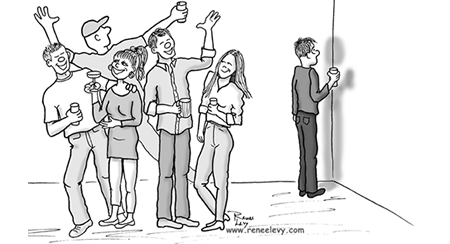
College is a stressful time for most students and it can quite often seem too difficult to cope with the pressures commonly found on college campuses. For someone with social anxiety, a disorder characterized by persistent fear of negative evaluation by others in social situations, this reality is all too real. They are faced with public speaking, graded class participation, and the anxiety of interacting with other students in clubs, organizations, and even at parties. And don’t forget the terror of meeting your new roommate! Being completely emerged in these situations makes it easy to feel like your social anxiety is inhibiting you in all aspects of your college life; however, this does not need to be the case.

There are plenty of things you can do to treat your social anxiety before it gets in the way of your college experience. For some, self-help techniques are useful. Participating in deep breathing exercises and positive self-talk are such techniques. Deep breathing helps to alleviate some of the physical symptoms of social anxiety, while positive self-talk can lessen the effect that anxiety has on negative thoughts. However, others benefit from psychotherapy, such as cognitive behavioral therapy, or medications (antidepressants) targeted for social anxiety. This treatment plan typically includes exposure therapy, which gradually places you in anxiety-provoking situations while simultaneously teaching you relaxation skills to cope with your anxiety. It can help you to understand the irrational basis of your worries. A combination of psychotherapy, medication, and at home self-help strategies are an effective way to prevent your social anxiety from taking over your college experience.

If you or someone you know appears to be suffering from social anxiety disorder, the licensed psychologists, psychiatrists, psychiatric nurse practitioners, and psychotherapists at Arista Counseling & Psychotherapy can assist you. Contact our Paramus, NJ or Manhattan, NY offices respectively, at (201) 368-3700 or (212) 722-1920 to set up an appointment. For more information, visit http://www.counselingpsychotherapynjny.com/

Group Therapy

Alice Cordero

According to psychcentral.com, Group therapy is a form of psychotherapy treatment where several people meet together under the supervision of a therapist in a particular setting. Group therapy is a form of therapy that can be used in conjunction with individual therapy and medication.  The benefits of group therapy include:

  • Modeling
    • Patients are able to witness how others in the group cope with their problems in positive ways and apply it to their lives.
    • Patients learn from other group member’s mistakes.
  • Helps improve social skills
    • In group therapy, most of the time each individual has to share something about themselves and how they are doing; this helps improve the patient’s interpersonal relationships and understand that they are not alone in this particular process.
  • Increased feedback
    • Provides patients with different perspectives/ coping methods
    • Gives patients a view of how others handle their particular situation
    • Provides individuals with personal feedback through other patients perceptions of themselves
  • Support Network
    • Having multiple individuals who are going through the same gives each patients the opportunity to build a support system that they can use


Group therapy involves members expressing their feelings, problems, ideas, and reactions towards other members. Studies have shown that group therapy has been effective in addressing countless problems, including: anxiety, depression, addictive disorders, substance abuse, death, lifestyle issues, and relationship issues.

If you or someone you know is suffering from any of the conditions listed above or think you/ they could benefit from group therapy, please contact our psychotherapy offices in New York or New Jersey to talk to one of our licensed professional psychologists, psychiatrists, psychiatric nurse practitioners, or psychotherapists at Arista Counseling & Psychotherapy. Contact our Paramus, NJ or Manhattan, NY offices respectively, at (201) 368-3700 or (212) 722-1920 to set up an appointment. For more information, please visit http://www.counselingpsychotherapynjny.com/.

Self-Harm

Self-harm is a way of expressing feelings that can’t be put into words by deliberately harming the surface of your own body, such as cutting or burning yourself. It’s the release of pain and tension one feels inside. It’s a distraction from overwhelming feelings and emotions, from no emotion at all, and can be used as a way to punish oneself.  It’s a way to feel control.

Dear readers that self-injure,             
            Maybe you feel ashamed, maybe you think no one would understand, maybe you think you won’t be left alone again, and quite honestly you might be scared of hearing that you’re crazy. But hiding who you are and what you feel is a heavy burden. We have all been there in one way or another. Truthfully, the secrecy and guilt of self-harm affects your relationships with your friends and family members and the way you feel about yourself. It can make you feel even more lonely, worthless, and trapped. But you are not crazy, and you are definitely not alone.

Why You Should Stop:

  • The relief is short lived.
  • Keeping the secret is a lonely and a difficult journey.
  • You can hurt yourself badly, on purpose or not, and misjudge the damage you’ll do.
  • Those who care for you, even those who are unaware of the situation, would be broken to know it.

How to Rid Yourself of the Mechanism:

  • Communicate with somebody you can confide in. A friend, a family member, a teacher, etc.
  • Give yourself time to heal.
  • Seek out professional help and begin to both work with and understand your emotions.
  • Sprint, draw, paint, sing, scream, run, cry, and do whatever you can to make your impulse go away in that moment.

How to Help Someone that Does Self-harm:

  • Don’t judge.
  • Respect the person’s time needed to heal.
  • Offer support, even if you might not completely understand.
  • Help find therapy, and offer to help reach out to more adults and professionals.

By Isabelle Kreydin

 If you or someone you know is self-harming and needs help, please contact our psychotherapy offices in New York or New Jersey to talk to one of our licensed professional psychologists, psychiatrists, psychiatric nurse practitioners, or psychotherapists at Arista Counseling & Psychotherapy. Contact our Paramus, NJ or Manhattan, NY offices respectively, at (201) 368-3700 or (212) 722-1920 to set up an appointment. For more information, please visit http://www.counselingpsychotherapynjny.com/.

https://www.helpguide.org/articles/anxiety/cutting-and-self-harm.htm