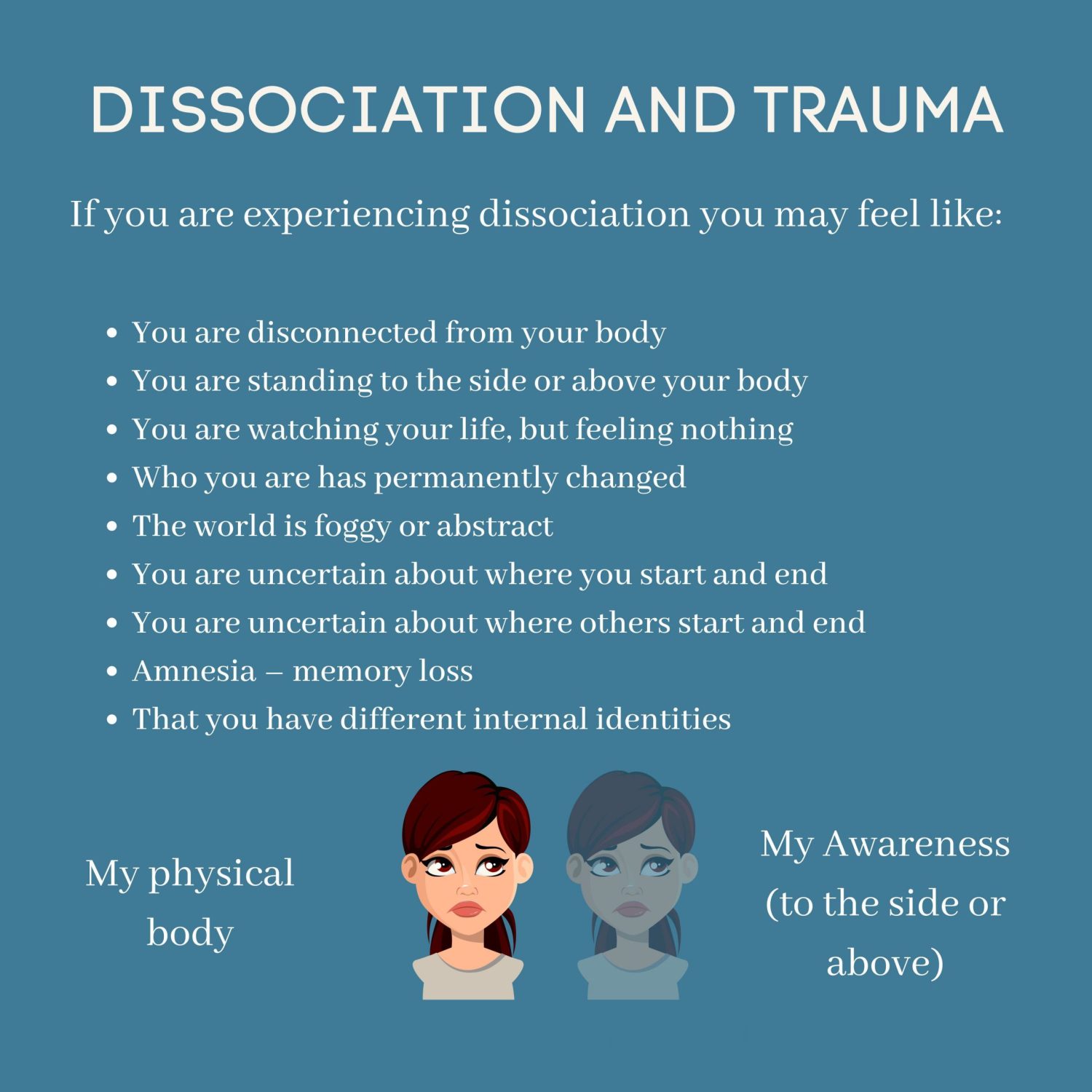
Trauma Related Dissociation

Trauma Related Dissociation

By: Julia Rzadkowska

Dissociation is when you completely disconnect from reality or even your identity. When people dissociate they detach from their thoughts, feelings, memories, behaviors, and physical sensations. Dissociation is a way some people’s bodies respond to a perceived threat or traumatic event such as abuse, or prolonged exposure to a traumatic situation or emotion. Dissociation can be looked at as a mental escape, when physical escape is not possible in a certain situation. Dissociation can affect memory, the sense of one’s identity, the way the world is perceived, along with the connection to the physical body.

At the time of trauma or overwhelming distress dissociation may be helpful. However, dissociation does not always have to occur in the presence of traumatic events. Following trauma, a trigger my cause the person to dissociate. These triggers may be completely nonthreatening to others, however, for some specific reason they cause this person negative emotions and overwhelming feelings, causing dissociation as a defense mechanism.  The body may dissociate often in times when it is not helpful, which can negatively impact someone’s life. This can cause people to have difficulty learning in school, remembering events in their life, or feeling connected in their personal relationships.

This type of problematic dissociative experience can become very confusing and hard to understand for the person. If you believe dissociation is having a negative impact on your life it is important to find someone you are comfortable talking to.

If you or someone you know is seeking therapy for Trauma Related Dissociation, please contact our psychotherapy offices in New York or New Jersey to talk to one of our licensed professional psychologists, psychiatrists, psychiatric nurse practitioners, or psychotherapists at Arista Counseling & Psychotherapy. Contact our Paramus, NJ or Manhattan, NY offices respectively, at (201) 368-3700 or (212) 722-1920 to set up an appointment. For more information, please visit http://www.counselingpsychotherapynjny.com/  

Sources:

https://www.orygen.org.au/Training/Resources/Trauma/Fact-sheets/Dissociation-trauma/Orygen_Dissociation_and_trauma_in_young_people_fac?ext=.

https://www.isst-d.org/public-resources-home/fact-sheet-iii-trauma-related-dissociation-an-introduction/

Psychotherapy: Benefits of Rational Emotive Behavior Therapy (REBT)

By: Jasmyn Cuate

Rational emotive behavior therapy (REBT) is a type of cognitive behavioral therapy (CBT) that focuses on helping people recognize and change negative thinking patterns into positive, healthier ones. This method is an action-oriented approach helping to overcome any psychological problems or mental distress. The goal of REBT is to help people respond rationally to situations that would cause stress, depression, or other negative feelings. How does it work?

The ABC model is one concept of REBT. The model suggests that we may blame external situations for our unhappiness and it is our interpretation of these situations that truly causes the psychological distress. ABC stands for:

  • A: Activating event, when something happens in your environment
  • B: Belief, describes your thoughts about the situation
  • C: Consequence, which is your emotional response to your belief

With REBT, your therapist will help you learn how to apply the ABC model in your daily life. Your therapist may help you identify the activating event before encouraging you to figure out which belief led you to your negative feelings. Once you’ve identify the underlying issue, your therapist will work with you to change those beliefs and your emotional response towards the issue. Before changing your belief, a process called disputation takes place where your therapist will challenge your irrational beliefs using direct methods such as asking questions which causes you to re-think or have you imagine another point of view that you may have not considered before. REBT can help with Anxiety, Social anxiety disorder, distress, Depression, Disruptive behavior in children, Obsessive-compulsive disorder (OCD) and Psychotic symptoms.

Benefits of REBT:

  • Reduce feelings of anger, depression, anxiety, and distress
  • Improves health and quality of life
  • Better social skills and school performance

REBT helps you understand that you are worthy of self-acceptance no matter what even if you or others are struggling; there is no need for shame or guilt because everyone makes mistakes and it’s normal to feel some discomfort. REBT gives insight that others are also worthy of acceptance even if their behavior involves something you don’t like. Overall, REBT helps you have a healthy emotional response on learning from a situation and moving on. This allows you to understand that negative things will sometimes happen in life therefore there is no rational reason to always expect it to be positive when faced with a situation.

If you or someone you know is seeking for cognitive behavioral therapy or rational emotive behavior therapy, please contact our psychotherapy offices in New York or New Jersey to talk to one of our licensed professional psychologists, psychiatrists, psychiatric nurse practitioners, or psychotherapists at Arista Counseling & Psychotherapy. Contact our Paramus, NJ or Manhattan, NY offices respectively, at (201) 368-3700 or (212) 722-1920 to set up an appointment. For more information, please visit http://www.counselingpsychotherapynjny.com/

Source: https://www.verywellmind.com/rational-emotive-behavior-therapy-2796000

Fear of Abandonment in Relationships

Fear of Abandonment in Relationships

By: Julia Rzadkowska

Do you ever sit and fear that those who you love will suddenly leave you? That your friends, family, or partner, will turn on you and suddenly reject you, pushing you out of their lives? You may be happy in the relationship, having the best time of your life, and then, all of a sudden, you are overcome with anxiety that you will be left alone, leaving you insecure. This is known as the fear of abandonment. It often stems from childhood loss. This can be the death of a parent, divorce, a traumatic event, or not receiving enough physical or emotional care as a child. Such events can lead to a fear of abandonment later in life. However, relationships in adulthood can also bring this fear into future relationships.

Slight fear of abandonment can be normal, however, when it becomes very severe and frequent it can tremendously impact someone’s life negatively. As people do not know how to cope with this fear, it can lead to the fear becoming a reality. Fear of abandonment can cause people to attach too quickly, even to unavailable partners, or fail to commit fully, pushing them to move on quickly in order to not get too attached. Additional qualities of someone who has this fear include the tendency to overthink and work to find hidden meanings in the words or actions of their partner. Jealousy is also a strong feeling and the feeling of insecurity and unworthiness to be loved. The person also frequently self-blames and has feelings of anxiety or depression.

If the partner realizes this fear, just words of reassurance are not usually enough to combat the fear. Some coping strategies include getting educated on the topic in order to gain knowledge about your tendencies and learn new behavioral strategies. Therapy is a good option for those who are struggling with a fear of abandonment.

If you or someone you know is struggling with a fear of abandonment, please contact our psychotherapy offices in New York or New Jersey to talk to one of our licensed professional psychologists, psychiatrists, psychiatric nurse practitioners, or psychotherapists at Arista Counseling & Psychotherapy. Contact our Paramus, NJ or Manhattan, NY offices respectively, at (201) 368-3700 or (212) 722-1920 to set up an appointment. For more information, please visit http://www.counselingpsychotherapynjny.com

Sources:

https://www.verywellmind.com/fear-of-abandonment-2671741

https://www.psychalive.org/fear-of-abandonment/

Trauma: The Impact of Inter-generational Trauma

The concept of intergenerational trauma was first recognized in 1966, by Canadian psychiatrist Vivian M. Rakoff, MD, when she discovered high rates of psychological distress among children of Holocaust survivors. Intergenerational trauma is trauma that isn’t just experienced by one person but extends from one generation to the next. Some of the examples are domestic violence, alcohol and drug, refugees, and survivors of combat/war trauma.

Trauma affects genetic processes, possibly by   epigenetic mechanisms affecting DNA function or gene transcription. Furthermore, microglia is the brain’s immune system. When in a constant trauma reactive state, microglia can eat away at the nerve instead of enhancing growth, which then can lead to genetic changes. Researchers have much to discover about its impact and how it looks within certain populations.  

Everyone is susceptible to intergenerational trauma, but there are specific populations that are vulnerable due to their histories. For instance, populations that have been systematically exploited endured continuous abuse, racism, and poverty. Like survivors of the 2004 tsunami in Asia or African Americans in the United States

A wide range of behaviors were observed in the offspring of Holocaust survivors: feelings of over‐identification and fused identity with parents, impaired self‐esteem stemming from minimization of offspring’s own life experiences in comparison to the parental trauma, tendency towards catastrophizing, worry that parental traumas would be repeated, a sense of a shorten future, mistrust and behavioral disturbances such as experiencing anxiety, traumatic nightmares, dysphoria, guilt, hypervigilance and difficulties in interpersonal functioning. Trauma can mask itself through learned beliefs, behaviors, and patterns that can become engrained.

If you or someone you know is seeking therapy for intergenerational trauma, please contact our psychotherapy offices in New York or New Jersey to talk to one of our licensed professional psychologists, psychiatrists, psychiatric nurse practitioners, or psychotherapists at Arista Counseling & Psychotherapy. Contact our Paramus, NJ or Manhattan, NY offices respectively, at (201) 368-3700 or (212) 722-1920 to set up an appointment. For more information, please visit http://www.counselingpsychotherapynjny.com/

https://www.health.com/condition/ptsd/generational-trauma

https://www.ncbi.nlm.nih.gov/pmc/articles/PMC6127768/

Illustration by therapist Ayan Mukherjee

Depression: How Does it Affect Relationships

By: Jasmyn Cuate

Depression is one of the most common types of mental illness that Americans struggle with each day affecting approximately 1 in 6 Americans. Depression is characterized by feelings of sadness, emptiness, or hopelessness, irritability, angry outbursts, or low frustration tolerance, loss of interest in or ability to enjoy usual activities, sleep disturbance, fatigue and lack of energy, appetite disturbance, agitation, anxiety, feelings of worthlessness and guilt, difficulty concentrating, remembering things, making decisions, recurring thoughts of death, and thoughts of suicide.

Many individuals struggling with depression describe it as living in a heavy fog where you lose clarity about your life, start to have self-doubt, changing the way you view friends, family, and partners as well as how you think they view you.

Although many relationships experience problems, a partner dealing with depression or trying to help their partner overcome depression, may find themselves having more challenges to their relationship. Depression can cause overwhelming emotions such as detachment, distrust, and vulnerability. It can cause the partner to pay little attention to the other partner, be less involved, more irritable, start arguments, and have trouble enjoying time together. Factors such as high levels of conflict, lack of communication, difficulty resolving problems, and withdrawal can lead to depression.

Untreated depression can cause a cycle of self-destructive behaviors that can tear relationships apart. Research has shown that when one member of a couple has depression, there is an impact on the well-being of the other partner as well. In fact, BMC Public Health has found that partners of those with mental illnesses, show signs of anxiety and depression themselves.

If you or someone you know is seeking therapy for depression or experiencing relationship problems due to depression, please contact our psychotherapy offices in New York or New Jersey to talk to one of our licensed professional psychologists, psychiatrists, psychiatric nurse practitioners, or psychotherapists at Arista Counseling & Psychotherapy. Contact our Paramus, NJ or Manhattan, NY offices respectively, at (201) 368-3700 or (212) 722-1920 to set up an appointment. For more information, please visit http://www.counselingpsychotherapynjny.com/

Sources: https://www.psychologytoday.com/us/basics/depression/signs-depression

https://blogs.scientificamerican.com/mind-guest-blog/the-warning-signs-that-depression-is-affecting-your-relationship/

Night Terrors: Terror Filled Sleep for Children

Unlike nightmares, night terrors are consistent episodes of intense screaming, crying, trashing, or fear during sleep. These episodes are reoccurring and usually occur in children between the ages of 3-12. About 1 to 6 in 100 children have night terrors, which occur in both boys and girls and children of all races. Night terrors are very rare, occur 3-6% in children, and typically tend to run in families. About 80% of children have a family member who experiences the same thing.

How are night terrors different from nightmares?

  • Nightmares commonly occur during REM sleep, while night terrors do not and will occur during non-REM sleep. You might find that it is hard to wake your child during a night terror episode and they will most likely not remember what occurred the next morning.

Signs & Symptoms:

  • Fast heart rate
  • Fast breathing
  • Sweating
  • Dilated pupils
  • Flailing around in bed
  • Screaming
  • Looks awake but confused
  • Not talking
  • Non-responsive
  • Cannot recognize that a parent is there
  • Acts upset or scared

What causes Night Terrors?

Night terrors are caused by an over-arousal of the central nervous system during sleep. The following factors have been noted in children who have experienced night terrors:

  • Overtired, ill, or stressed
  • Taking new medicine
  • Sleeping in a new environment
  • Not getting enough sleep
  • Having too much caffeine

How can you help your child?

The best way to help your child is to wait it out and make sure they do not get hurt during the night terror episode. Also, it is important to note that it is best to not wake your child during the episode. Waking them during this episode can cause more disorientation and confusion. However, you can help prevent future night terrors by:

  • Reducing the child’s stress
  • Create a bedtime routine that is relaxing and simple
  • Make sure the child gets enough sleep
  • Do not let your child stay up too late

If night terrors occur repeatedly, talk to your child’s doctor to see if further evaluations and/or referrals are needed.

If you are someone you know appears to be suffering from issues linked to night terrors, please contact our psychotherapy offices in New York or New Jersey to talk to one of our licensed professional psychologists, psychiatrists, psychiatric nurse practitioners, or psychotherapists at Arista Counseling & Psychotherapy. Contact our Paramus, NJ or Manhattan, NY offices respectively, at (201)368-3700 or (212)722-1920 to set up an appointment. For more information, please visit http://www.counselingpsychotherapynjny.com/.

Sources: https://kidshealth.org/en/parents/terrors.html

https://www.webmd.com/sleep-disorders/night-terrors

Image: https://www.alaskasleep.com/blog/night-terrors-vs-nightmares-how-to-help-terrified-child

The Relationship between OCD and Eating Disorders

The Relationship between OCD and Eating Disorders

By: Suzanne Zaugg

Eating disorders are characterized as obsessive, repetitive thoughts, and ritualistic behaviors. Obsessive-compulsive disorder (OCD) is a common, chronic long lasting disorder that characterizes uncontrollable thoughts or behaviors that an individual may feel they need to repeat certain things over and over. Statistics show that people with eating disorders are more likely to show signs of OCD, due to the overlapping traits of both OCD and eating disorders.

Understanding the similarities and differences between eating disorders and OCD can help develop a more comprehensive understanding of a patient that presents both of these disorders. People with an eating disorder may experience intrusive thoughts about food and body image, and may develop ritualistic behaviors. Examples of ritualistic behavior pertaining to eating disorders include body checking for any changes in shape or size, frequent weight checking, and skipping meals. An important distinction between OCD and eating disorders lies in the relationship between the thought and action of the individual.  People with OCD are typically interested in ridding themselves of their thoughts and feelings whereas; people with eating disorders may feel more tied to the components of this disorder and feels as if it is a part of their identity.

Since both eating disorders and OCD share overlapping diagnostic characteristics, treatments will look similar. Both exposure therapy and cognitive behavior therapy are very helpful treatments for both eating disorders and OCD. Exposure therapy is a psychological treatment that involves exposing the patient to the anxiety source or its context without the intention to cause any danger. Also, cognitive-behavior therapy is a treatment approach that helps you recognize negative or unhelpful thought patters.

If you or someone you know is seeking therapy for an eating disorder, please contact our psychotherapy offices in New York or New Jersey to talk to one of our licensed professional psychologists, psychiatrists, psychiatric nurse practitioners, or psychotherapists at Arista Counseling & Psychotherapy. Contact our Paramus, NJ or Manhattan offices respectively, at (201) 368-3700 or (212) 722-1920 to set up an appointment. For more information, please visit http://www.counselingpsychotherapynjny.com/

Sources:

https://www.waldeneatingdisorders.com/blog/eating-disorders-and-ocd-a-complicated-mix/

Anxiety and Tests

Anxiety and Tests

 As universities are opening up and students are returning back to the classroom, students may feel increases in test anxiety as they return to an academic setting. While some anxiety may be a good motivator for studying, a crippling amount of anxiety can result in a decrease in grades and an increased risk of mental health issues. Here are some tips to conquer testing anxiety.

  • Study Smarter, Not Harder: Make sure you’re prepared for the test. Don’t cram and don’t spend too long stressing over the subject. Ask friends and family for help, and set goals to help you reach your potential in different subjects.
  • Focus on the positives: Negativity can be a self-fulfilling prophecy. If you tell yourself you’ll do poorly, you’ll end up not having the motivation to study and thus do poorly. Practice positive self-talk and set realistic goals for yourself.
  • Build Good Habits: Manage your time wisely. Make sure to get enough sleep the day before the test and eat something nutritious the morning of the test.
  • Do Relaxation Exercises: There are a number of ways to alleviate physical symptoms. Do breathing exercises, count backwards from one hundred, and meditate. Find out which relaxation technique works best for you.

            As everyone returns to the classroom there will be an adjustment period. Be proactive in helping your test anxiety and practice the methods that work best for you.

If you or someone you know is seeking therapy for an anxiety disorder, please contact our psychotherapy offices in New York or New Jersey to talk to one of our licensed professional psychologists, psychiatrists, psychiatric nurse practitioners, or psychotherapists at Arista Counseling & Psychotherapy. Contact our Paramus, NJ or Manhattan, NY offices respectively, at (201) 368-3700 or (212) 722-1920 to set up an appointment. For more information, please visit http://www.counselingpsychotherapynjny.com/

SOURCE: https://www.therapistaid.com/therapy-guide/treating-test-anxiety#references

Abuse: Signs of Gaslighting in an Emotionally Abusive Relationship

Abuse: Signs of Gaslighting in an Emotionally Abusive Relationship

By: Julia Taormina

An emotionally abusive relationship can sometimes go undetected, as there is no physical evidence of abuse. Thus, it is important to be aware of signs that can indicate you or someone you know is in an emotionally abusive relationship. One of the most unnoticed signs is gaslighting.

As defined by the National Domestic Violence Hotline, “gaslighting is an extremely effective form of emotional abuse that causes a victim to question their own feelings, instincts, and sanity, which gives the abusive partner a lot of power.” Gaslighting is typically gradual throughout the course of a relationship, making it easy to go unnoticed in the beginning stages. It can start out with small comments such as: “I don’t know what you’re talking about,” or “you’re too sensitive,” and leave you questioning yourself.
Listed below are multiple gaslighting techniques an abusive partner may use:

  • Withholding: pretends not to understand or refuse to listen
  • Countering: questions the victim’s memory of events
  • Blocking / Diverting: changes the subject or questions the victim’s thoughts
  • Trivializing: makes the victim’s feelings appear unimportant

Throughout the gaslighting techniques, there is a consistent theme of an abusive partner invalidating the victim as a whole. The victim may find they are constantly second-guessing themselves, feel as if they are going crazy, constantly make excuses for their partners’ behaviors, cannot do anything right, and overall feel that something is wrong in the relationship but cannot quite put it into words. If you feel any of these may apply to your relationship, you are not alone.

If you or someone you know is seeking therapy, please contact our psychotherapy offices in New York or New Jersey to talk to one of our licensed professional psychologists, psychiatrists, psychiatric nurse practitioners, or psychotherapists at Arista Counseling & Psychotherapy. Contact our Paramus, NJ or Manhattan, NY offices respectively, at (201) 368-3700 or (212) 722-1920 to set up an appointment. For more information, please visit http://www.counselingpsychotherapynjny.com/

Source:
https://www.thehotline.org/resources/types-of-abuse/

Image Source:
https://themighty.com/wp-content/uploads/2020/08/Untitled-design-2020-08-07T105137.107-1280×427.png?v=1597442092

Borderline Personality Disorder in Men

Borderline Personality Disorder in Men

By Jenn Peraza

Borderline Personality Disorder (also known as BPD) is a personality disorder that is categorized in the DSM-V by intense fears of abandonment, emotional instability in everyday life and relationships, and a distorted sense of self. Studies have found that while BPD is equally as prevalent in men as it is in woman, statistically speaking, seventy-five percent of people with BPD are female. So why are females most likely to get diagnosed with BPD?

While the criteria for men and women with BPD are the same, men and women are more likely to exhibit different maladaptive behaviors. Women will most likely self-harm through eating disorders and cutting while men will more likely self-harm using substances and head banging. Due to this, men are more likely to end up in prison for violent behavior while women are more likely to seek mental health resources to deal with their self-harm.

There’s also a societal stigma around men receiving mental health help. While women are seen as emotional creatures, men are seen as unemotional and are told to “suck it up” or “man up” when they’re upset. Another factor is that the maladaptive behaviors of BPD are discouraged in women and encouraged in men. Men who have tumultuous relationships, aggressive behavior, and exert violent behavior are more likely praised in society than women who express the same symptoms.
Despite this, it is necessary to clear one’s mind of what is seen as typical behavior for men and to encourage the men in your lives to seek mental health help. By overcoming stigmas, more men can receive the necessary help for BPD and live fulfilling lives.

If you or someone you know is seeking therapy for a personality disorder, please contact our psychotherapy offices in New York or New Jersey to talk to one of our licensed professional psychologists, psychiatrists, psychiatric nurse practitioners, or psychotherapists at Arista Counseling & Psychotherapy. Contact our Paramus, NJ or Manhattan, NY offices respectively, at (201) 368-3700 or (212) 722-1920 to set up an appointment. For more information, please visit http://www.counselingpsychotherapynjny.com/

SOURCE:  https://www.verywellhealth.com/borderline-personality-disorder-in-men-5096081