Groupthink and Conformity

Groupthink and Conformity

By Crystal Tsui

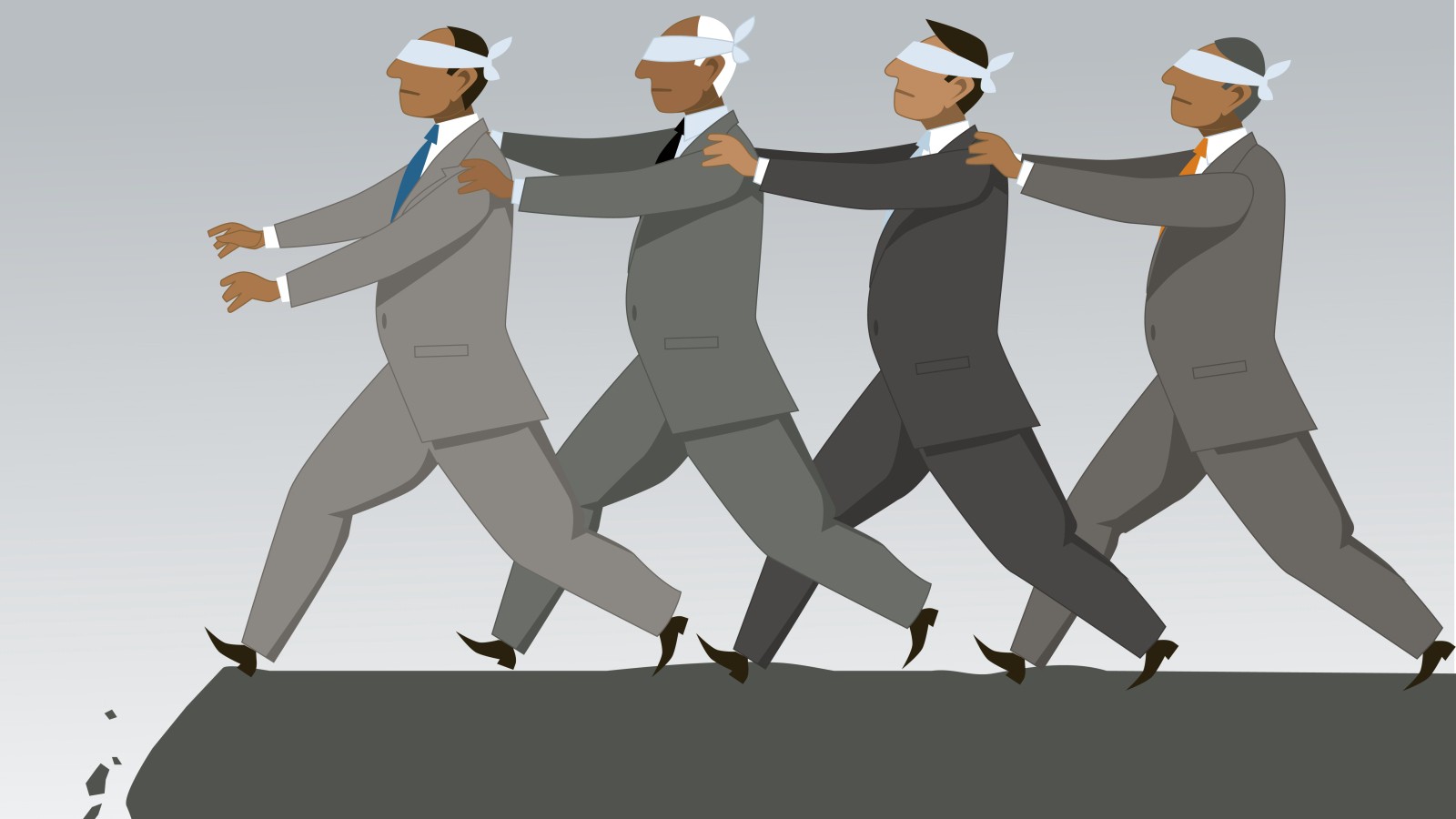
Have you ever been in a group and did not agree with the group’s decision, but had to agree because they would reject your idea?  Irving Janis, a social psychologist, first coined the term groupthink to describe this situation. His main aim was to understand how a group of individuals collectively come up with excellent decisions one time and fail at other times. Groupthink happens when a group of people with good intentions, but they make irrational decisions that are spurred by the urge to conform. Group members value harmony and coherence above rational thinking and refrain from expressing doubts and judgements or disagreeing with the consensus.

Irving Janis observed the following eight patterns of groupthink:

  1. Illusions of Invulnerability: when the group displays excessive optimism and takes big risks, the members of the group feel that anything they do will turn out to be successful.
  2. Collective Rationalization: when the group rationalizes thoughts or suggestions that challenge what the majority is thinking
  3. Belief in Inherent Morality of the Group: the belief that whatever the group does will be right. This causes the group members to overlook the consequences of what they decide.
  4. Out Group stereotypes: is the belief that those who disagree are opposing just to oppose the group
  5. Direct Pressure on Dissenters: the majority directly threatens the opposing group member by telling them that they can always leave the group if they don’t agree.
  6. Self-Censorship: the opposing individual believes that if they are the only odd one out then they must be the one who is wrong.
  7. Illusions of Unanimity: Silence from some is considered acceptance of the majority’s decision
  8. Self-Appointed Mind Guards: Members of the group who take it upon themselves to discourage alternative ideas from being expressed in the group.

There are numerous studies supporting the fundamentals of groupthink and conformity. One famous study was the Asch Conformity experiment. Solomon Asch gathered his participants to take a vision test where three lines at varied lengths were compared to one other; which was longer. The participants were asked to identify the lines with matching lengths. Ninety-five percent of participants answered every question correctly. Then Asch placed actors in the groups, who confidently volunteered the same incorrect answer. The accuracy dropped to 25 percent, indicating that 75 percent of the participants went along with the group’s incorrect answer for at least one question.

An Emory University neuroscientist, Gregory Berns, found that when we take a stance different from the group, we activate the amygdala, a small region in the brain associated with the fear. We don’t like to be rejected so we refrain from speaking up against the group, which supports Janis’ pattern of groupthink: Direct Pressure on Dissenters. Professor Berns defined this situation as “the pain of independence.” Many government decisions are cited as a result of groupthink, such as the Vietnam War or the invasion of Iraq.

Groupthink also fosters a strong “us vs. them” mentality that prompts members to accept group perspectives in the heat of the moment, where there is also a strong pressure from the outside to make a good decision. An example in literature is George Orwell’s Animal Farm, where the animals make a nonunanimous decision to rid the farm of humans. There were animals there that quite adored being loved and owned by a human, however, those animals had to agree because the leader of the animals would punish them otherwise.

After periodically experiencing groupthink, an individual may become shy and become more introverted. They may be afraid to speak and include their own ideas in fear of the group rejecting their idea.

If you or someone you know have social anxiety and fear of speaking up, please contact our psychotherapy offices in New York or New Jersey to talk to one of our licensed professional psychologists, psychiatrists, psychiatric nurse practitioners, or psychotherapists at Arista Counseling & Psychotherapy. Contact our Paramus, NJ or Manhattan, NY offices respectively, at (201) 368-3700 or (212) 722-1920 to set up an appointment. For more information, please visit http://www.counselingpsychotherapynjny.com/ .

Sources:

https://www.psychologytoday.com/us/basics/groupthink

https://www.communicationtheory.org/groupthink/

https://www.capitalideasonline.com/wordpress/the-pain-of-independence/

https://counselingrx.com/wp-content/uploads/2019/07/f74c8-1d9gxs1dxyteswk7e7zgd2q.jpeg

Shyness and Introversion

Shyness and Introversion

By Crystal Tsui

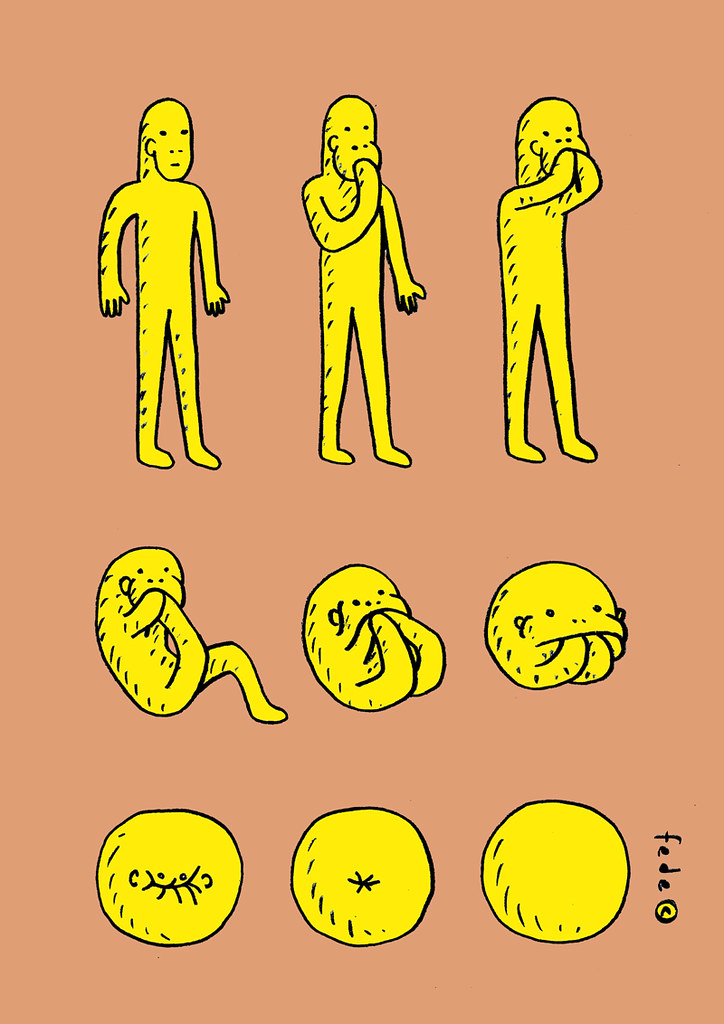
We all know someone who prefers to stay in rather than go out and party or someone who barely talk in a group setting. We may call them shy, quiet, or maybe socially awkward. But they may just be an introvert. Introversion and shyness are often times used together. However, shyness revolves around the fear of negative judgment while introversion is the preference for quiet, minimally stimulating environments. So it is possible for a person to be a shy extrovert, where the individual is afraid to speak up, fearing negative judgment, more so than exhausted in a certain social situation.

Despite the difference, there is also an overlap between shyness and introversion, e.i. many shy people are introverted. Some people are born with “high-reactive” temperaments that predispose them to both shyness and introversion. A shy person may become more introverted over time, motivated to discover the pleasures of solitude, other minimally stimulating social environments, and to move away from judgments. On the other hand, an introvert may become shy after continually receiving the message that there’s something wrong with them.

There’s a shared bias in our society against both shyness and introversion. Neither trait is welcomed in our society because studies have shown that we rank the fast and frequent talkers as more competent, likeable, and even smarter than slow and quiet talkers.

Here are 5 ways introverts can spend time that is deeply fulfilling and socially connected:

  1. Reading. Books transcend time and place. Studies have shown that reading fiction increases empathy and social skills.
  2. Enter a state of “flow” by doing work or a hobby that you love. Flow is the transcendent state of being, in which you feel totally engaged in an activity. People in flow don’t tend to wear the broad smiles of enthusiasm. When you watch them in action, the words “joy” and “excitement” don’t come to mind. But the words “engagement,” “absorption,” and “curiosity” do.
  3. Keep an informal quota system of how many times per week/month/year you plan to go out to social events and how often you get to stay home. This way you can plan which parties or get-togethers you can truly enjoy and which you don’t. So you are less likely to drive yourself mad thinking you should’ve stayed home.
  4. Have meaningful conversations.
  5. Spend time and show affection to the ones you love, whose company is so dear and comfortable that you feel neither over-stimulated nor anxious in their presence.

If you or someone you know is dealing with social anxiety or suffering from a disruption of their social life, please contact our psychotherapy offices in New York or New Jersey to talk to one of our licensed professional psychologists, psychiatrists, psychiatric nurse practitioners, or psychotherapists at Arista Counseling & Psychotherapy. Contact our Paramus, NJ or Manhattan, NY offices respectively, at (201) 368-3700 or (212) 722-1920 to set up an appointment. For more information, please visit http://www.counselingpsychotherapynjny.com/ .

Sources:

https://www.quietrev.com/wp-content/uploads/2015/05/QR_ebookMay8-2015.pdf

https://www.nytimes.com/2012/01/15/opinion/sunday/the-rise-of-the-new-groupthink.html?_r=0

https://live.staticflickr.com/627/21427437162_910d54e08e_b.jpg

Learning How to Face Rejection

rejection

By: Tamar Asayan

Everyone has experienced rejection whether it was not getting the job you wanted, your friends not inviting you somewhere and posting about it online, or even having someone not like you back. Rejection is the loss of something you may have once had or wanted. It is similar to abandonment because it leaves you feeling less than and unwanted. Unfortunately, rejection is something that cannot be avoided and it is a part of life that everyone will have to experience. No matter how small or big the rejection you experience is, it is always going to hurt you and leave an emotional wound. Not only does rejection cause emotional pain, but it also damages someone’s self-esteem and effects one’s mood resulting in frustration and anger. An article, “Why Rejection Hurts So Much-and What to do About it” states, “The same areas of our brain become activated when we experience rejection as when we experience physical pain. That’s why even small rejections hurt more than we think they should, because they elicit literal pain” (Winch). If you are feeling the pain of being rejected here are some ways to cope and overcome it in healthier ways.

  1. Acknowledge the pain and grief of loss
  • When you are rejected, you may feel embarrassed and don’t know how to exactly cope with it. You may repress your feelings and ignore the fact that you are in pain.
  • In order to accept rejection, you must accept the pain of what you are going through. Whether it is crying, going to therapy, exercising, or even journaling, it is important to relieve and express the emotions faced when being rejected.
  1. Don’t blame yourself
  • Most of the time you don’t understand why you have been rejected and naturally you place the blame on yourself.
  • The reason you believe you are at fault is because early in life you may have been taught to believe that you are not enough.
  • Do not take responsibility for what is out of your control.
  1. Put yourself out there
  • Rejection is part of the process which leads to success. Do not take it personally, it’s part of life.
  • Putting yourself out there can make you less sensitive to rejection; the more you are rejected the less it hurt us.
  1. Build your resiliency
  • To be resilient is to be able to recover or come back from a stressful or traumatizing event.
  • Resiliency can be learned by doing some of the following:
    • Having an open mind
    • Seeking solutions
    • Learning from an experience
    • Seeking support
    • Knowing your worth and strengths
    • Self-care

If you or someone you know is feeling rejected or dealing with rejection, call now to make an appointment to speak with one of our licensed professional psychologists, psychiatrists, psychiatric nurse practitioners, or psychotherapists. Contact us at our Paramus, NJ (201) 368-3700 or Manhattan, NY offices at or (212) 722-1920 to set up an appointment. For more information, visit http://www.counselingpsychotherapynjny.com/.

Sources: https://psychcentral.com/blog/how-to-overcome-rejection-like-a-champ/

https://ideas.ted.com/why-rejection-hurts-so-much-and-what-to-do-about-it/

https://blogs.psychcentral.com/imperfect/2019/02/4-strategies-to-cope-with-the-pain-of rejection/

Image: https://www.dailymail.co.uk/femail/article-1327598/Why-rejection-good-you.html

Alcohol Abuse: College Students

Alcohol Abuse: College Students

By Toniann Seals

For many, college is the first time in one’s young adult life that they are away from their families and on their own. Without direct supervision they begin to experiment, especially with alcohol. Unfortunately, some find themselves victims of alcohol abuse and have a hard time fighting the addiction.

Identifying Alcohol Abuse:

  • Missing important assignments, classes or meetings because of alcohol
  • Vomiting each time you drink alcohol
  • Not able to control the amount you drink
  • Drinking before or during class/work
  • Constant feeling of regret after a night out of drinking
  • Inability to control your behaviors while under the influence
  • Binge Drinking

Some may claim that they are just trying to have “fun” in college, however being a college student does not make a person immune to the detrimental side effects of alcohol abuse.

According to the NIAAA, “Approximately 2 out of every 5 college students of all ages (more than 40 percent) reported binge drinking at least once in the 2 weeks prior.” Drinking too much alcohol in a short period of time can lead to health problems, injury and even death. Fitting in is not worth what could potentially happen to you. If you are drinking because of stress, a traumatic experience or bad breakup, professional help could be very beneficial.

If you or someone you know is dealing with alcohol abuse speak with one of our licensed professional psychologists, psychiatrists, psychiatric nurse practitioners, and psychotherapists. Contact us at our Paramus, NJ or Manhattan, NY offices at (201) 368-3700 or (212) 722-1920 respectively to set up an appointment. For more information, visit http://www.counselingpsychotherapynjny.com/.

Sources:

https://www.addictioncenter.com/alcohol/binge-drinking/

(Image) http://allaboutaddiction.com/addiction/college-students-binge-drinking/

Ever Feel Like a Fraud?

By: Stephanie Osuba

Despite your degrees, acclaims, and accomplishments, do you ever sometimes feel like you are an imposter? That you’ve been getting lucky or that you’re a fake in your profession and one day people are going to find you out? As it turns out, you aren’t alone. Many successful people feel this way and often have to step back and remember all the things they have achieved – Maya Angelou and Albert Einstein among these people! While there is no diagnosis or even proper name for this feeling in the DSM-5, there are countless of reports of this in psychology and psychotherapy literature. In fact, the first time the term “imposter syndrome” was used was in an article in 1978 by Drs Pauline R. Clance and Suzanne A. Imes who – after studying 150 educated, established, and highly respected women – found that they didn’t have an internal sense of success and found themselves to be “imposters.”

So what causes this “imposter syndrome” that befalls so many successful people? One reason could be that there is no real measure to success. There is always something more that you can do and regardless of how much success you’ve already had and you think you are content with, self-doubt can always creep in and say you haven’t done enough. Another reason could be “pluralistic ignorance,” which is believing something to be true without being able to prove or disprove it – usually involving unspoken or false beliefs about other people. For example, research has shown that all college students feel anxiety about school but the actual students think they are the only ones who feel that way and other people are having no trouble adjusting to college life. And lastly, talent can make us believe that we haven’t worked hard enough and don’t deserve the praise or success of what comes naturally to us.

Source: https://www.psychologytoday.com/us/blog/the-couch/201811/do-you-ever-feel-fraud 

If you or someone you know appears to be having issues with self-esteem or is suffering from anxiety, the licensed psychologists, psychiatrists, psychiatric nurse practitioners, and psychotherapists at Arista Counseling & Psychotherapy can assist you. Contact our Paramus, NJ or Manhattan, NY offices respectively, at (201) 368-3700 or (212) 722-1920 to set up an appointment. For more information, visit http://www.counselingpsychotherapynjny.com/

College Stress

By: Charleene Polanco

Change is a natural part of life. Some people gladly welcome change and growth, while others tend to panic when the stability of what they are used to is gone. College is one of the biggest transitions a person can experience, because it is a time for independence. Leaving the safety of your house, parents, and friends is necessary to have new experiences and make connections. College introduces a change in lifestyle, greater workload, different responsibilities, and new relationships. With all of these changes, many students experience college stress because they are unable to effectively handle the different aspects of their lives. College stress is more common than we think, with six out of ten students experiencing stress to the point of it becoming detrimental to their college lives. The symptoms of college stress include headaches, fatigue, depression, anxiety, and an inability to cope.  The more serious symptoms of college stress are suicidal thoughts, drug/alcohol abuse, social withdrawal, physically violent outbursts, and uncontrollable crying.

Since stress is so prevalent among college students, there are many tips available to help reduce and cope with stress. It is recommended that college students seek out stress management resources. On college campuses, there are many resources available to students, which can help them manage their lives. Counseling services are one of the many resources designed to hear student’s problems and provide them with solutions. If a person is uncomfortable with contacting counseling services, they can start out by talking to a trusted friend, advisor, or family. However, if you are experiencing the more serious symptoms of college stress, it is highly encouraged that you seek out counseling services or other professional resources.

If you or someone you know is suffering from college stress, please contact our psychotherapy offices in New York or New Jersey to talk to one of our licensed professional psychologists, psychiatrists, psychiatric nurse practitioners, or psychotherapists at Arista Counseling & Psychotherapy. Contact our Paramus, NJ or Manhattan, NY offices respectively, at (201) 368-3700 or (212) 722-1920 to set up an appointment. For more information, please visit http://www.counselingpsychotherapynjny.com/.

Sources:

NYU. “Stress.” Stress, NYU, www.nyu.edu/life/safety-health-wellness/live-well-nyu/priority-areas/stress.html

“Student Guide to Balancing Stress.” Best Colleges, Best Colleges , 28 June 2018, www.bestcolleges.com/resources/balancing-stress/.


ADHD in Teens: Why Adult Support is Essential

By Stephanie Osuba

Common symptoms of ADHD lead people to believe that students that have been diagnosed willingly choose to not complete assignments or be inattentive during class. However, symptoms like forgetfulness, procrastination, distractibility, poor time management, and having a difficult time writing are exactly what prohibits a student from achieving academic success. By definition, these teens cannot manage their time on their own, not even with all the motivation in the world. And although these students want to be treated normally, it is important to intervene in order to teach them how to manage their ADHD and their lives.

Wanting to be “normal” often prevents these students from seeking the help that they need with assignments and time management. While school counselors mean well with their open office doors, it’s important to recognize when a student with ADHD is falling behind. The student, even if a need for help is stated, will often not follow through with appointments due to the lack of executive control and interfering symptoms like distractibility and impulsivity. Setting up a comprehensive academic plan with the teen takes the efforts of parents and teachers who constantly check in to make sure he or she is on track. How you can support a student with ADHD:

  • Promote independence: the end goal is to have the teen be able to keep track of assignments, organize himself, be able to take notes, study well, and mange his time by being able to break down projects. Have the student come up with his own plan for the school year and check in if it seems off base. Once a well-oiled routine is put in place, check in regularly.
  • Intervene early: always prompt students to solve academic problems immediately. It’s better to catch small mistakes and setbacks early on than to wait until they snowball out of control.
  • Provide guidance: you should aim to collaborate with the teen in finding solutions to any problem that arises, however, most need direct instruction at first. They need to be shown exactly what the outcome needs to be before they can decide on the best way to arrive at the desired solution.
  • Take the lead: students should be under adult supervision at all times. At school, it’d be teachers and counselors and at home it’s their parents or guardians.
  • Gradually withdraw supports: adult supervision shouldn’t be completely withdrawn until the student proves capable. Symptoms can cause poor executive function well through college because it largely interferes with academic skills no matter their age.

Source: M.D., M. B. (2018, September 24). The Pivotal Role of Adults in Teen ADHD Care. Retrieved from https://www.psychologytoday.com/us/blog/child-development-central/201809/the-pivotal-role-adults-in-teen-adhd-care 

If you or someone you know is struggling with ADHD, the licensed psychologists, psychiatrists, psychiatric nurse practitioners, and psychotherapists at Arista Counseling & Psychotherapy can assist you. Contact our Paramus, NJ or Manhattan, NY offices respectively, at (201) 368-3700 or (212) 722-1920 to set up an appointment. For more information, visit http://www.counselingpsychotherapynjny.com/

Self-esteem

By: Charleene Polanco

Have you ever experienced a time in your life when you felt that, “you weren’t good enough?” If you have, self-esteem is at the core of this feeling, because it involves perceptions one has of oneself. These perceptions eventually become beliefs about self-worth and value. That is why self-esteem is so important in a person’s life, because how people think of themselves, is what drives them towards or away from certain actions. High self-esteem is often associated with multiple accomplishments in life. This is because people with high self-esteem, believe that they are worthy of the opportunities they get, and, therefore, make the most out of them. One the other hand, those with low self-esteem, constantly believe that they are not good enough. When an opportunity presents itself to them, people with low self-esteem feel like they do not deserve it, and do not perform their best. This is why low self-esteem is associated with depression and anxiety. If you are suffering from low self-esteem, here are a couple of tips available to raise self-esteem:

  • Identify triggers of low self-esteem: if you are able to recognize the places or people that lower your self-esteem, you are able to avoid or prepare for them. This way, learning experiences come from each event.
  • Avoid negative self-talk: if you do not think negatively about yourself, you are able to feel better and attempt things you would normally avoid.
  • Connect with loved ones: family members and friends can be great emotional support because people who care about you, will also make you feel loved and wanted. Nurture these feelings so that eventually you are able to see yourself as they do, and will slowly learn how to love yourself a little more each day.

If you or someone you know is suffering from low self-esteem, please contact our psychotherapy offices in New York or New Jersey to talk to one of our licensed professional psychologists, psychiatrists, psychiatric nurse practitioners, or psychotherapists at Arista Counseling & Psychotherapy. Contact our Paramus, NJ or Manhattan, NY offices respectively, at (201) 368-3700 or (212) 722-1920 to set up an appointment. For more information, please visit http://www.counselingpsychotherapynjny.com/.

Sources:

Gross, S. J. (2016, July 17). How To Raise Your Self-Esteem. Retrieved October 8, 2018, from https://psychcentral.com/lib/how-to-raise-your-self-esteem/

Mind for Better Mental Health. (2013). How to increase your Self-esteem. Retrieved October 8, 2018, from https://www.mind.org.uk/information-support/types-of-mental-health-problems/self-esteem/#.W9cKgY2WyM8


Insomnia

By: Dianna Gomez

Insomnia is a condition that makes it very difficult for a person to fall asleep and stay asleep throughout the night. Insomnia can be caused by medical conditions such as hyperthyroidism, or for psychological reasons such as anxiety, depression or intrusive thoughts. In addition to these possibilities, the type of lifestyle an individual chooses to live can also be responsible for creating symptoms of insomnia. There are a few things that people who experience insomnia tend to do that may be worsening their symptoms without them even knowing. Some examples of these lifestyle habits include:

  1. Taking Mid-Day Naps
  • Whether it is short or long, sleeping in the middle of the day can increase a person’s chances of having difficulty sleeping through the night. If you can, try to avoid taking naps all together.
  1. Sleeping In Late
  • When a person is lacking sleep, it isn’t uncommon for them to attempt to fix the problem by sleeping in later the next morning to make up for their “lost hours.” However, by doing so, you are confusing your body clock which then makes it difficult to fall asleep at a regular time again the following night. This can quickly create a vicious cycle that is even harder to break.
  1. Taking Your Work Home With You
  • Regardless of what your occupation is, almost everybody has hectic daily schedules. When people are feeling behind on their work, they often decide to put in a little “over-time” by bringing their work home with them. By doing this, you make the process of “winding down” at night harder as your mind is kept wide awake and pre-occupied when it shouldn’t be.
  1. Using Electronics
  • Especially in today’s generation, it is extremely common for people to use their phones or laptops while lying in bed right before they intend to fall sleep. The problem with this, however, is that bright screens like those on our electronics actually stimulate the brain more and cause you to stay awake. This then makes it more difficult to fall asleep for the night.
  1. Working Irregular Hours
  • If you have a job that has you on various different “shifts,” sleeping may become a problem for you. If a person doesn’t stay on a regimented time schedule, their body clock cannot decipher when it should be waking up to take on a new day or winding down to get ready for bed.


If you have already tried reversing these lifestyle habits and still regularly experience symptoms of insomnia, the licensed psychologists, psychiatrists, psychiatric nurse practitioners, and psychotherapists at Arista Counseling & Psychotherapy can help you. Contact our Paramus, NJ or Manhattan, NY offices respectively, at (201)-368-3700 or (212)-722-1920 to set up an appointment. For more information, visit us at https://www.counselingpsychotherapynjny.com/.


Anxiety: Social Anxiety Disorder

By: Charleene Polanco

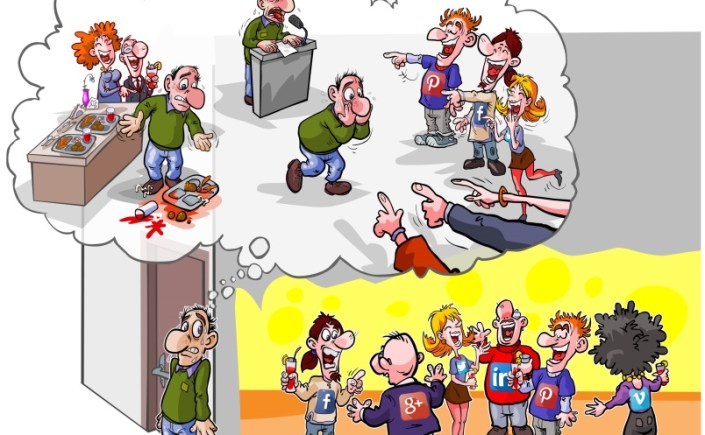
Social anxiety disorder is characterized by an intense fear of being rejected by people. Many people feel some level of anxiety when they are placed into unknown social situations. However, those suffering from social anxiety disorder may avoid socializing altogether, because they cannot handle being judged or seen in a negative way by others. A person with social anxiety disorder, can experience anxiety during many different situations like; going on a date, eating in front of people, making eye contact, public speaking, or going to parties. Some of the symptoms of social anxiety include:

  • Rapid heartbeat
  • Uneasy stomach/diarrhea
  • Muscle tension
  • Lightheadedness
  • Sweating

Social anxiety can cripple a person’s life, because normal everyday interactions are triggers of anxiety and discomfort. This is why many people who suffer from social anxiety disorder choose to isolate themselves from everyone. In order to reduce the fear of rejection, people with social anxiety disorder are encouraged to be exposed to social situations, not run away from them. Although being around others is what brings them distress, socializing is also what allows people with social anxiety to change the way they think about social engagements. Instead of having negative perceptions about the way people view them, the more they socialize and are accepted by others, the more socially anxious people see that those perceptions are not true.

If you or someone you know is suffering from social anxiety, please contact our psychotherapy offices in New York or New Jersey to talk to one of our licensed professional psychologists, psychiatrists, psychiatric nurse practitioners, or psychotherapists at Arista Counseling & Psychotherapy. Contact our Paramus, NJ or Manhattan, NY offices respectively, at (201) 368-3700 or (212) 722-1920 to set up an appointment. For more information, please visit http://www.counselingpsychotherapynjny.com/.

Sources:

Anxiety and Depression Association of America. (2018). Social Anxiety Disorder. Retrieved October 01, 2018, from https://adaa.org/understanding-anxiety/social-anxiety-disorder

Nordqvist, C. (2018, February 05). What’s to Know About Social Anxiety Disorder? Retrieved October 01, 2018, from https://www.medicalnewstoday.com/articles/176891.php

WebMD. (2018). What Is Social Anxiety Disorder? Retrieved October 01, 2018, from https://www.webmd.com/anxiety-panic/guide/mental-health-social-anxiety-disorder#1