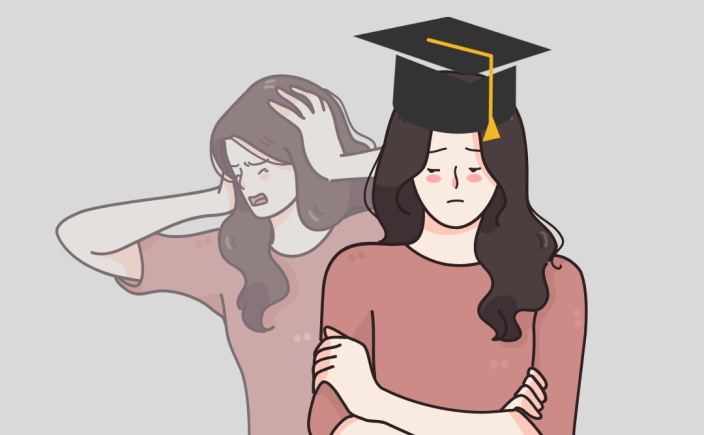
Anxiety: First Day of College as a Freshman

Anxiety: First Day of College as a Freshman

By Colleen Susanto

Feeling anxious about college is a universal experience. Especially, when someone has just graduated from high school and is starting college. It’s a huge transition for everybody. College is the time where you find yourself and experience the adult life. So, what makes us so anxious about college and how can we overcome it?

Being in a new community can be really intimidating. Trying to fit in and making new friends. Not being able to be with your old friends from high school can make you feel separated. However, one way to avoid that feeling is to socialize. Many colleges offer programs and events and that way, you can meet new people and make friends!

The stress of keeping up with academic expectations can also be very overwhelming. College classes tend to be more work than high school and can feel overwhelming when you are not organized. What you could do is to write down the assignments, deadlines, and exams. Then, you’d feel more organized and plan ahead.

Last but not least, being away from home. First time in college is usually the first time a student is away from their family. They have to carry huge responsibilities, such as financial, independence, time management, and much more. These can be very overwhelming for first timers. You could always contact your family through texts and calls, and stay connected with them. Try talking out your problems with your family or people you know to take some of the burden off you.

If you or someone you know is struggling with mental health, please contact our psychotherapy offices in New York or New Jersey to talk to one of our licensed professional psychologists, psychiatrists, psychiatric nurse practitioners, or psychotherapists at Arista Counseling and Psychotherapy. Contact our Paramus, NJ, or Manhattan, NY offices respectively, at (201)-368-3700 or (212)-722-1920 to set up an appointment. For more information, please visit https://www.counselingpsychotherapynjny.com/

https://truetherapyaz.com/managing-stress-overwhelm-for-first-time-college-students/

Social Anxiety: Social Anxiety vs. Introversion

Social Anxiety: Social Anxiety vs. Introversion

By, Maro Mikhaeil

People often find themselves confusing social anxiety with just being shy. This leaves many individuals go undiagnosed and may even worsen overtime. But what’s the difference?

First and foremost, social anxiety disorder is characterized as feeling symptoms of anxiety when it comes to social situations. Social anxiety is the feeling of being judged by others causing one to feel suppressed and feel unable to express oneself. One who feels symptoms of anxiety when presenting in front of a class or even have trouble making friends may be experiencing social anxiety.

However, introversion can certainly look the same as well. Introversion is characterized as being quiet most of the time in social situations and feeling more energy when spending time alone. An introverted individual spends time alone as a way of recharging for a social event and is a choice as opposed to individuals who experience social anxiety.

Individuals who experience social anxiety want to connect with others but feel held back because of the anxiety that is attached to the idea. They will often use alone time not to recharge themselves but as a way of protecting themselves and ultimately avoiding a social situation altogether.

If you or someone you know is struggling with their mental health, and may be experiencing social anxiety please contact our psychotherapy offices in New York or New Jersey to talk to one of our licensed professional psychologists, psychiatrists, psychiatric nurse practitioners, or psychotherapists at Arista Counseling & Psychotherapy. Contact our Paramus, NJ or Manhattan, NY offices respectively, at (201) 368-3700 or (212) 722-1920 to set up an appointment. For more information, please visit http://www.counselingpsychotherapynjny.com/.

Sources:

https://www.nimh.nih.gov/health/publications/social-anxiety-disorder-more-than-just-shyness#:~:text=They%20feel%20symptoms%20of%20anxiety,of%20situations%20or%20social%20interactions.

https://www.psychologytoday.com/us/basics/shyness#what-causes-shyness

https://mhanational.org/introversion-vs-social-anxiety#:~:text=With%20social%20anxiety%2C%20avoidance%20of,care%20rather%20than%20self%2Dprotection.

Post-Grad Depression

Depression/Post-College

By: Ingrid Guevara

Everyone knows and acknowledges that depression during college occurs. Statistics show that twenty-seven percent of college students had been diagnosed with depression and twenty-three percent said that depression impacted their academic performance negatively.  When it comes to post-grad students research shows that around twenty percent of student graduating experience depression. Post-grad depression is seen as situational depression. Situational depression is depression caused by a stressful or traumatic event. Post-Grad depression is caused by; pressure of finding a job, moving back in with parents, feeling a failure to launch, changes in friendships (friends scattering, not seeing them), student debt, comparison with friends and being overwhelmed by next steps and changes. Signs of post-grad depression are; lack of motivation, feeling worthless or guilty, loneliness, overwhelm (especially related to the next steps), feeling sad or down, isolation or wanting to isolate oneself, not enjoying activities that were previously enjoyed, poor sleep, appetite change, lower than usual frustration tolerance, feeling sluggish or super jittery and intense fear or expectation things will not go well in the future. Post-grad depression like any depression can really hinder your life so seeking help is suggested in order to properly cope with it. It is also suggested; avoiding comparing yourself with others, practice self-kindness and self-love, reach out to friends,  get some exercise/movement, don’t be too hard on yourself, recognize that transitions are difficult, find a support group/networking group, take care of yourself and confide in trusted family and friends. Depression is common when life is stressful and one feels pressure therefore, it is okay because always remember you are not alone.

If you or someone you know is struggling with their mental health, please contact our psychotherapy offices in New York or New Jersey to talk to one of our licensed professional psychologists, psychiatrists, psychiatric nurse practitioners, or psychotherapists at Arista Counseling & Psychotherapy. Contact our Paramus, NJ or Manhattan, NY offices respectively, at (201) 368-3700 or (212) 722-1920 to set up an appointment. For more information, please visit http://www.counselingpsychotherapynjny.com/

References

https://www.ncbi.nlm.nih.gov/pmc/articles/PMC9091131/

February: Teen Dating Violence Awareness and Prevention Month

By: Julia Massa

Teen dating violence, also known as intimate partner violence or intimate relationship violence, affects one in three teenagers, ages 12 to 19 nationwide. This population is likely to experience physical, sexual, or emotional abuse from their partner before entering adulthood. The abuse can take many forms including stalking, harassment, or physical or sexual abuse. In fact, 10% of adolescents report being a victim of physical violence prior to experiencing sexual assault or rape. Girls are more vulnerable to experience violence in their relationships and are likely to develop suicidal ideations, eating disorders, or use drugs. In addition, adolescents are likely to carry these behaviors into future relationships.

The month of February signifies the undying efforts to raise awareness for teen dating violence by promoting advocacy and education to younger individuals so that they can notice the red flags and escape potential abuse from a partner. This year’s theme for Teen Dating Violence Awareness and Prevention Month is “Talk About It,” which encourages younger individuals to participate in conversations differentiating both healthy and unhealthy relationships. It is important to note that this is an issue that affects not only teenagers, but their families, friends, and the community as a whole. Many cases go unreported since victims are hesitant and scared to open up to their family or peers about it.

Safety planning guides, participating in the That’s Not Cool Ambassador Program, attending webinars, supporting youth led projects, and advocating through social media platforms are various ways an individual can spread awareness and enhance their knowledge on ways to help victims notice patterns of abuse. On February 8th, it is encouraged to wear orange to show victims that they have our support and attention. Love is Respect.

If you or someone you know is struggling with being in an abusive relationship, please contact our psychotherapy offices in New York or New Jersey to talk to one of our licensed professional psychologists, psychiatrists, psychiatric nurse practitioners, or psychotherapists at Arista Counseling & Psychotherapy. Contact our Paramus, NJ or Manhattan, NY offices respectively, at (201) 368-3700 or (212) 722-1920 to set up an appointment. For more information, please visit http://www.counselingpsychotherapynjny.com/

Sources:

https://youth.gov/feature-article/teen-dating-violence-awareness-and-prevention-month

Image Source:

Burnout in College Students (Part 1)

Tatyana A. Reed

With school coming into full swing, before we can even get that deep, it’s time to look at burnout, particularly in students. Have you ever taken on way too many tasks and at the last minute realized it’s causing an overwhelming feeling of exhaustion and being stressed out? Or have you ever been so busy you feel like nothing is going to get done correctly or done at all? If you have felt like this, nine times out of ten you were experiencing burnout.

According to pyschologytoday.com burnout is “a state of emotional, mental, and often physical exhaustion brought on by prolonged or repeated stress.” Burnout is not a widely talked about topic unless the causes have been detrimental to an individual. In this article, we will talk about the symptoms, affects, and how to avoid burnout.

DIFFERENCE BETWEEN STRESS AND BURNOUT

Before we can talk about the signs of burnout, we first have to understand that there is a difference between burnout and stress. David Ballard, member of the American Psychological Association, describes burnout as “an extended period of time where someone experiences exhaustion and a lack of interest in things, resulting in a decline in their job [academic] performance.”

SIGNS OF BURNOUT

Here are just some of the early indicators of college burnout according to collegeinfogeek.com:

  • Constant exhaustion
  • Lack of motivation
  • Constant frustration
  • Grades beginning to decline
  • Struggling to pay attention
  • Disengagement from friends and colleagues

WHAT MAY BE CAUSING YOUR BURNOUT 

A study conducted by University of South Maine in 2006 had 354 students answer questions that helped look at why burnout may be happening to college students. Here are the four most prevalent answers:

  • 13% said it was due to lack of motivation on their personal part
  • 25% attributed it to issues caused by their part time job ( finance and lack of time) and due to family issues
  • 5% said it was caused by a professor
  • And the most prevalent answer was because of having too many assignments on their plate


If you or someone you know is dealing with burnout, please contact our psychotherapy offices in New York or New Jersey to talk to one of our licensed professional psychologists, psychiatrists, psychiatric nurse practitioners, or psychotherapists at Arista Counseling & Psychotherapy. Contact our Paramus, NJ or Manhattan, NY offices respectively, at (201) 368-3700 or (212) 722-1920 to set up an appointment. For more information, please visit http://www.counselingpsychotherapynjny.com/.


References:

Harrison, Mike. “Avoid College Burnout.” Great Lakes Christian College, 22 Jan. 2018, http://www.glcc.edu/avoid-college-burnout/ (PHOTO)

Jerry, Lisa M. “10 Signs you’re Burning Out — And What To Do About It.” Forbes, Forbes Magazine, 3 Jan. 2018, http://www.forbes.com/sites/learnvest/2013/04/01/10-signs-youre-burning-out-and-what-to-do-about-it/.

Stephanie Cushman & Richard West (2006) Precursors to College Student Burnout: Developing a Typology of Understanding, Qualitative Research Reports in Communication, 7:1, 23-31, DOI: 10.1080/17459430600964638

Vaiana, Dominic. “Burnout in College: What Causes It and How to Avoid It.” College Info Geek, 5 Mar. 2019, collegeinfogeek.com/student-burnout/