Dialectical Behavior Therapy (DBT): a Cognitive Behavioral Approach

Dialectical Behavior Therapy (DBT): a Cognitive Behavioral Approach

By: Jasmyn Cuate

Dialectical behavior therapy (DBT) is a combination of cognitive and behavior therapy, supported by empirical-based evidence that teaches patients skills to cope with and change unhealthy behaviors. The main goals of DBT are to teach people how to live in the moment, develop healthy ways to cope with stress, regulate their emotions, and improve their relationships with others.

DBT focuses on four key areas in therapeutic skills:

  • Mindfulness: focuses on improving your ability to accept and be present in the current moment, helping you use healthy coping skills instead of using negative impulsive behaviors
  • Distress tolerance: teaches you how to feel intense emotions without reacting impulsively or using self-injury or substance abuse to escape from it. Helping you prepare for intense emotions and cope with a more positive long-term outlook
  • Emotion regulation: teaches you how to identify, label, and change your emotions without judging them– learning how your emotions shape your behavior and what obstacles prevent you from managing your emotions, reducing your emotional vulnerability and helps you have more positive emotional experiences
  • Interpersonal effectiveness: allows you to communicate more effectively with others, become more assertive, maintain self-respect and respect for others, while keeping a relationship positive and healthy

DBT goes through a multistage approach where the therapist first treats the patient’s most self-destructive behavior followed by the therapist addressing quality-of-life skills, then focus on improving the patient’s relationships and self-esteem, with the last stage focusing on promoting more joy and relationship connections. Standard comprehensive DBT is often used in the following settings:

  • Individual therapy: with a trained professional, you learn how to apply DBT skills to specific challenges and situations in your life­– patients agree to do homework to practice new skills and fill out diary cards which are completed daily to keep track of their emotions, urges, behaviors, and skills used throughout the week and brought to weekly sessions for the therapist and client to discuss and see if there’s progress being made. Diary cards are designed to record instances of target behaviors, thoughts and urges, and the use of behavioral skills client’s applied to cope with the problem
  • Group skills training: patients have the opportunity to role-play new behavioral skills and interact with others
  • Phone coaching: with DBT, your therapist is available by the phone for in-the-moment support between sessions if you’re in a difficult situation and need guidance

While your therapist works with you through the DBT approach, it can be challenging to stay motivated. Therefore, therapists have consultation groups,which are a group of professionals who met regularly helping one another to navigate potential stressors, monitor their devotion to treatment, develop and increase their skills, and sustain their motivation to work with high-risk, difficult-to-treat clients.

DBT was developed by Marsha Linehan, originally intended to treat borderline personality disorder (BPD) and suicidal behaviors but has been modified to treat other mental health conditions and have been effective in treating:

  • Borderline personality disorder (BPD)
  • Bipolar disorder
  • Substance use or impulsive behaviors
  • Eating disorders
  • Depression
  • Post-traumatic stress disorder (PTSD)
  • Non-suicidal self-injury (NSSI) or suicidal behavior
  • Generalized anxiety disorder (GAD)
  • Attention-deficit/hyperactivity disorder (ADHD)

Overall, DBT offers validation for patients, helping them understand their actions within the context of their personal experiences without necessarily agreeing that their actions are the best approach to solving a problem. This helps patients become more likely to cooperate and work towards self-acceptance and change. The best way to find out if DBT is right for you is to talk with a professional. They will evaluate your symptoms, treatment history, and therapy goals to see if DBT is the best treatment option for you.

If you or someone you know is seeking for dialectical behavior therapy, please contact our psychotherapy offices in New York or New Jersey to talk to one of our licensed professional psychologists, psychiatrists, psychiatric nurse practitioners, or psychotherapists at Arista Counseling & Psychotherapy. Contact our Paramus, NJ or Manhattan, NY offices respectively, at (201) 368-3700 or (212) 722-1920 to set up an appointment. For more information, please visit http://www.counselingpsychotherapynjny.com/

Sources: https://www.webmd.com/mental-health/dialectical-behavioral-therapy https://www.psychologytoday.com/us/therapy-types/dialectical-behavior-therapy

https://www.verywellmind.com/dialectical-behavior-therapy-1067402

https://psychcentral.com/lib/an-overview-of-dialectical-behavior-therapy

Borderline Personality Disorder: A Battle Within The Mind

Borderline Personality Disorder: A Battle Within The Mind

By: Arianna DiRaggio

Personality disorders can often go unnoticed. This is because they are typically difficult to spot and hard to treat. It is very easy to dismiss or look past one’s behavior and simply label it as their personality, never looking more into it. Since it is so difficult to spot, it is important for these individuals to seek help for themselves when the symptoms may be atypical or cause distress.

Borderline personality disorder, also known as BPD, is a mental health disorder characterized by instability and impulsivity. This instability and impulsivity often makes it difficult to function in everyday life.

Symptoms of BPD:

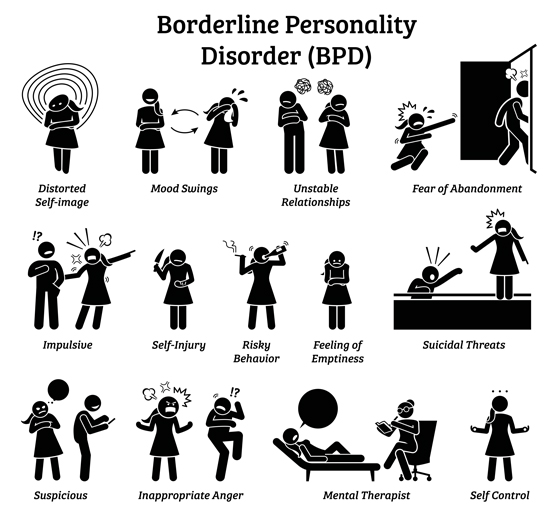
  • Efforts to avoid real or imagined abandonment
  • A pattern of unstable and intense interpersonal relationships
  • Persistent and unstable sense of self
  • Impulsive behaviors
  • Self-harming behavior
  • Rapidly changing mood swings
  • Feeling like they are “losing touch with reality”
  • Difficulty regulating emotional reactions

About 2% of adults are affected by BPD and 75% of those affected are women. Luckily, considerable amounts of research on BPD have been done over the years, allowing us to further understand and assist those struggling with BPD. Different forms of therapy, medications and holistic treatments have all shown positive effects in helping to suppress symptoms. 

If you or a loved one is suffering from Borderline Personality Disorder, please contact Arista Counseling & Psychotherapy, located in New York and New Jersey to speak to licensed professional psychologists, psychiatrists, psychiatric nurse practitioners or psychotherapists. To contact the office in Paramus NJ, call (201) 368-3700. To contact the office in Manhattan, call (212) 722-1920. For more information, please visit http://www.counselingpsychotherapynjny.com/ .

Sources: 

https://www.psychologytoday.com/us/basics/borderline-personality-disorder

https://www.mayoclinic.org/diseases-conditions/borderline-personality-disorder/symptoms-causes/syc-20370237

https://www.dummies.com/health/mental-health/borderline-personality-disorder-for-dummies-cheat-sheet/

Borderline Personality Disorder (BPD)

By: Estephani Diaz

Borderline Personality Disorder is a complex disorder with no certain explanation as to what causes it. This disorder is so uncommon, that it only affects about 5% of our population. It is considered to be a combination of schizophrenia, anxiety, impulsiveness, severe mood swings, etc. In order to be diagnosed with Borderline Personality Disorder, also known as BPD, you must have at least five out of the nine symptoms listed below:

  1. Perceived or real fears of abandonment
  2. Intense mood swings, severe depression or anxiety
  3. Impulsiveness
  4. Unstable intense relationships
  5. Self-injurious and suicidal behaviors
  6. Chronic feelings of emptiness
  7. Inappropriate, intense anger and rage
  8. Unstable sense of self
  9. Dissociation and feelings of detachment

Any combination of the symptoms above, can lead to family problems, ruin relationships, and cause anxiety, depression, and/or anger. BPD can last from a year to a lifetime. Those with BPD are recommended to seek talk therapy or group therapy. Medications can also be used, however, they would only be needed if one has a severe case of depression and/or mood swings. If help is not found, people with BPD have a high chance of abusing drugs, committing suicide, or worsening relationships with loved ones.

If you or someone you know is suffering from Borderline Personality Disorder, please contact our psychotherapy offices in New York or New Jersey to talk to one of our licensed professional psychologists, psychiatrists, psychiatric nurse practitioners, or psychotherapists at Arista Counseling & Psychotherapy. Contact our Paramus, NJ or Manhattan, NY offices respectively, at (201) 368-3700 or (212) 722-1920 to set up an appointment. For more information, please visit http://www.counselingpsychotherapynjny.com/.

Borderline Personality Disorder

By Jennifer Guzman

Border-What-personality?

Borderline Personality Disorder (BPD) is a common disorder categorized under “mood disorders” in the DSM. Although it is common, many individuals who have it are often misdiagnosed with Bipolar Disorder, as they share a few commonalities and may be easily confused. Very frequently, this may be the case, as studies have shown that a plethora of individuals who were diagnosed with Borderline Personality Disorder were previously diagnosed with Bipolar Disorder until they were properly diagnosed (Ruggero, Zimmerman, Chelminski, & Young, 2010). However, a key distinguisher between the two is that with Borderline Personality Disorder, mood shifts occur as a result of a situation, whereas mood shifts in a person with Bipolar Disorder may occur sporadically.

A few key symptoms for Borderline Personality Disorder are impulsive behavior, feeling as though you are unsure of your identity, frequent mood shifts, feeling bouts of extreme idealization or repulsion towards a person, place, or thing, extreme fear of abandonment, or difficulty/apprehension towards trusting in others.

Treatment procedures for Borderline Personality Disorder usually entail Dialectic Behavioral Therapy (DBT), which focuses on practicing mindfulness and the rewiring of harmful behaviors. Medication is provided as needed and varies from person to person. If you experience any of the above symptoms, please visit our psychologists, psychiatrists, psychiatric nurse practitioner, or psychotherapists. If you are in a crisis, please call 1-800-273-8255. For therapy, you can give Arista Counseling a call at (201) 368-3700, for our Paramus location, or (212) 722-1920 to set up an appointment.

Ruggero, C.J., Zimmerman, M., Chelminski, I., Young, D. (2010). Borderline Personality Disorder and the Misdiagnosis of Bipolar Disorder. Journal of Psychiatric Research. 44(6), 405-408.