Borderline Personality Disorder in Men

Borderline Personality Disorder in Men

By Jenn Peraza

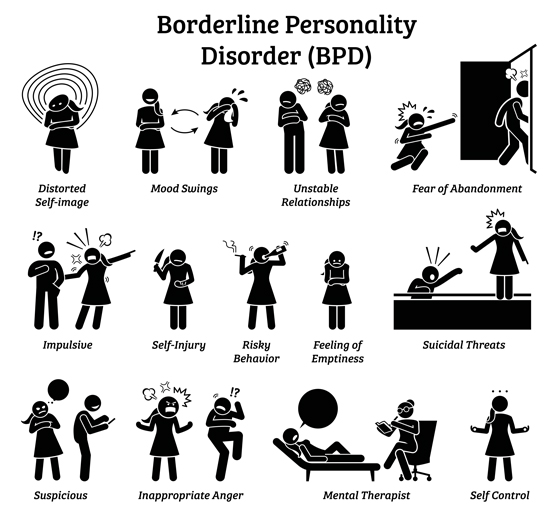
Borderline Personality Disorder (also known as BPD) is a personality disorder that is categorized in the DSM-V by intense fears of abandonment, emotional instability in everyday life and relationships, and a distorted sense of self. Studies have found that while BPD is equally as prevalent in men as it is in woman, statistically speaking, seventy-five percent of people with BPD are female. So why are females most likely to get diagnosed with BPD?

While the criteria for men and women with BPD are the same, men and women are more likely to exhibit different maladaptive behaviors. Women will most likely self-harm through eating disorders and cutting while men will more likely self-harm using substances and head banging. Due to this, men are more likely to end up in prison for violent behavior while women are more likely to seek mental health resources to deal with their self-harm.

There’s also a societal stigma around men receiving mental health help. While women are seen as emotional creatures, men are seen as unemotional and are told to “suck it up” or “man up” when they’re upset. Another factor is that the maladaptive behaviors of BPD are discouraged in women and encouraged in men. Men who have tumultuous relationships, aggressive behavior, and exert violent behavior are more likely praised in society than women who express the same symptoms.
Despite this, it is necessary to clear one’s mind of what is seen as typical behavior for men and to encourage the men in your lives to seek mental health help. By overcoming stigmas, more men can receive the necessary help for BPD and live fulfilling lives.

If you or someone you know is seeking therapy for a personality disorder, please contact our psychotherapy offices in New York or New Jersey to talk to one of our licensed professional psychologists, psychiatrists, psychiatric nurse practitioners, or psychotherapists at Arista Counseling & Psychotherapy. Contact our Paramus, NJ or Manhattan, NY offices respectively, at (201) 368-3700 or (212) 722-1920 to set up an appointment. For more information, please visit http://www.counselingpsychotherapynjny.com/

SOURCE:  https://www.verywellhealth.com/borderline-personality-disorder-in-men-5096081

Borderline Personality Disorder: A Battle Within The Mind

Borderline Personality Disorder: A Battle Within The Mind

By: Arianna DiRaggio

Personality disorders can often go unnoticed. This is because they are typically difficult to spot and hard to treat. It is very easy to dismiss or look past one’s behavior and simply label it as their personality, never looking more into it. Since it is so difficult to spot, it is important for these individuals to seek help for themselves when the symptoms may be atypical or cause distress.

Borderline personality disorder, also known as BPD, is a mental health disorder characterized by instability and impulsivity. This instability and impulsivity often makes it difficult to function in everyday life.

Symptoms of BPD:

  • Efforts to avoid real or imagined abandonment
  • A pattern of unstable and intense interpersonal relationships
  • Persistent and unstable sense of self
  • Impulsive behaviors
  • Self-harming behavior
  • Rapidly changing mood swings
  • Feeling like they are “losing touch with reality”
  • Difficulty regulating emotional reactions

About 2% of adults are affected by BPD and 75% of those affected are women. Luckily, considerable amounts of research on BPD have been done over the years, allowing us to further understand and assist those struggling with BPD. Different forms of therapy, medications and holistic treatments have all shown positive effects in helping to suppress symptoms. 

If you or a loved one is suffering from Borderline Personality Disorder, please contact Arista Counseling & Psychotherapy, located in New York and New Jersey to speak to licensed professional psychologists, psychiatrists, psychiatric nurse practitioners or psychotherapists. To contact the office in Paramus NJ, call (201) 368-3700. To contact the office in Manhattan, call (212) 722-1920. For more information, please visit http://www.counselingpsychotherapynjny.com/ .

Sources: 

https://www.psychologytoday.com/us/basics/borderline-personality-disorder

https://www.mayoclinic.org/diseases-conditions/borderline-personality-disorder/symptoms-causes/syc-20370237

https://www.dummies.com/health/mental-health/borderline-personality-disorder-for-dummies-cheat-sheet/

Borderline Personality Disorder (BPD): Understanding BPD and how to Appropriately Respond to Provocations as a Loved One

Living with Borderline Personality Disorder (BPD) not only affects the individual, but those with whom they have formed a relationship. Relationships are present and strong, but experience more turbulence due to key symptoms of BPD such as: intense reactions, self- doubt, extreme idolization or devaluation, fear of abandonment, mood swings, risky behaviors, etc. There is no one “cause” of a personality disorder like BPD, but studies show that patients with BPD come from families of severe pathology leading to their provocative behavior patterns.

People with BPD engage in provocative behaviors like making wild accusations, over- the- top demands, threatening suicide, etc., all with the intention of being invalidated by their counterparts as they have been their whole life. They feel invalidated (which fuels self- doubts) when they evoke one of three reactions from their counterpart: anxious helplessness, anxious guilt, or overt hostility. If these reactions are displayed, their poor behavior is rewarded and will continue, and feelings of self- doubt are reaffirmed.

When someone with BPD makes a wild accusation, resist invalidating them while disagreeing with the accusation. If they say, for example, “I can tell you hate me,” you can reply with, “I’m sorry you feel that way. I wish there was something I could do that would convince you I love you.” Here, you are disagreeing with the accusation while validating their feelings, and not showing one of the craved reactions. Their poor behaviors are thus not rewarded and feelings of self- doubt are not reaffirmed. Further, simply listen and be attentive. People with BPD most likely grew up being invalidated so they want to feel cared about. When talking to someone with BPD, incorporate the counseling technique “reflection of feelings”. This is defined by interpreting one’s feelings based on their verbal and nonverbal cues. When you’re able to interpret someone’s feelings, it demonstrates that you are paying attention and care, which is of utmost importance to someone with BPD.

If you or someone you know is seeking therapy for a codependent relationship, please contact our psychotherapy offices in New York or New Jersey to talk to one of our licensed professional psychologists, psychiatrists, psychiatric nurse practitioners, or psychotherapists at Arista Counseling & Psychotherapy. Contact our Paramus, NJ or Manhattan, NY offices respectively, at (201) 368-3700 or (212) 722-1920 to set up an appointment. For more information, please visit http://www.counselingpsychotherapynjny.com/

Sources:

https://www.nami.org/Personal-Stories/What-Is-BPD

https://www.psycom.net/personality-disorders/bpd-and-relationships/

https://www.psychologytoday.com/us/blog/matter-personality/201401/responding-borderline-provocations-part-iii

https://www.psychologytoday.com/us/blog/matter-personality/201403/responding-borderline-provocations-part-iv

https://www.psychologytoday.com/us/blog/matter-personality/201403/responding-borderline-provocations-part-v

https://www.psychologytoday.com/us/blog/matter-personality/201405/responding-borderline-provocations-part-vi

Borderline Personality Disorder

By Jennifer Guzman

Border-What-personality?

Borderline Personality Disorder (BPD) is a common disorder categorized under “mood disorders” in the DSM. Although it is common, many individuals who have it are often misdiagnosed with Bipolar Disorder, as they share a few commonalities and may be easily confused. Very frequently, this may be the case, as studies have shown that a plethora of individuals who were diagnosed with Borderline Personality Disorder were previously diagnosed with Bipolar Disorder until they were properly diagnosed (Ruggero, Zimmerman, Chelminski, & Young, 2010). However, a key distinguisher between the two is that with Borderline Personality Disorder, mood shifts occur as a result of a situation, whereas mood shifts in a person with Bipolar Disorder may occur sporadically.

A few key symptoms for Borderline Personality Disorder are impulsive behavior, feeling as though you are unsure of your identity, frequent mood shifts, feeling bouts of extreme idealization or repulsion towards a person, place, or thing, extreme fear of abandonment, or difficulty/apprehension towards trusting in others.

Treatment procedures for Borderline Personality Disorder usually entail Dialectic Behavioral Therapy (DBT), which focuses on practicing mindfulness and the rewiring of harmful behaviors. Medication is provided as needed and varies from person to person. If you experience any of the above symptoms, please visit our psychologists, psychiatrists, psychiatric nurse practitioner, or psychotherapists. If you are in a crisis, please call 1-800-273-8255. For therapy, you can give Arista Counseling a call at (201) 368-3700, for our Paramus location, or (212) 722-1920 to set up an appointment.

Ruggero, C.J., Zimmerman, M., Chelminski, I., Young, D. (2010). Borderline Personality Disorder and the Misdiagnosis of Bipolar Disorder. Journal of Psychiatric Research. 44(6), 405-408.