Borderline Personality Disorder: A Battle Within The Mind

Borderline Personality Disorder: A Battle Within The Mind

By: Arianna DiRaggio

Personality disorders can often go unnoticed. This is because they are typically difficult to spot and hard to treat. It is very easy to dismiss or look past one’s behavior and simply label it as their personality, never looking more into it. Since it is so difficult to spot, it is important for these individuals to seek help for themselves when the symptoms may be atypical or cause distress.

Borderline personality disorder, also known as BPD, is a mental health disorder characterized by instability and impulsivity. This instability and impulsivity often makes it difficult to function in everyday life.

Symptoms of BPD:

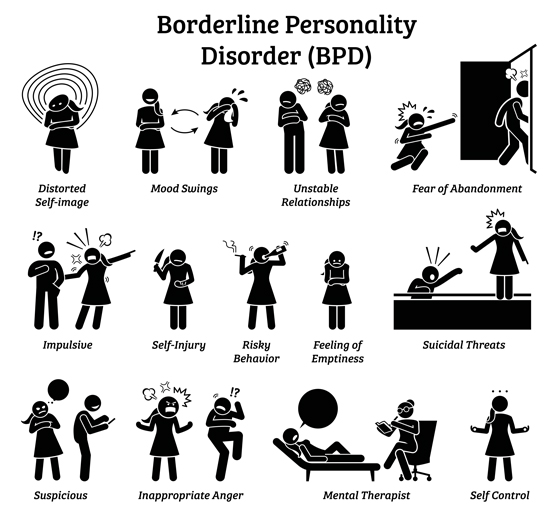
  • Efforts to avoid real or imagined abandonment
  • A pattern of unstable and intense interpersonal relationships
  • Persistent and unstable sense of self
  • Impulsive behaviors
  • Self-harming behavior
  • Rapidly changing mood swings
  • Feeling like they are “losing touch with reality”
  • Difficulty regulating emotional reactions

About 2% of adults are affected by BPD and 75% of those affected are women. Luckily, considerable amounts of research on BPD have been done over the years, allowing us to further understand and assist those struggling with BPD. Different forms of therapy, medications and holistic treatments have all shown positive effects in helping to suppress symptoms. 

If you or a loved one is suffering from Borderline Personality Disorder, please contact Arista Counseling & Psychotherapy, located in New York and New Jersey to speak to licensed professional psychologists, psychiatrists, psychiatric nurse practitioners or psychotherapists. To contact the office in Paramus NJ, call (201) 368-3700. To contact the office in Manhattan, call (212) 722-1920. For more information, please visit http://www.counselingpsychotherapynjny.com/ .

Sources: 

https://www.psychologytoday.com/us/basics/borderline-personality-disorder

https://www.mayoclinic.org/diseases-conditions/borderline-personality-disorder/symptoms-causes/syc-20370237

https://www.dummies.com/health/mental-health/borderline-personality-disorder-for-dummies-cheat-sheet/

Borderline Personality Disorder and Bipolar Disorder; Distinguishing Between the Two

Borderline Personality Disorder and Bipolar Disorder; Distinguishing Between the Two

By: Stacey Rodriguez

Borderline Personality Disorder (BPD) and Bipolar Disorder (BD) have many overlapping symptoms, causing them to manifest similarly. BPD is characterized by a pattern of unstable emotion, behavior and self-image. Similarly, BD is marked by unusual and extreme shifts in energy and mood.

Mood swings in the context of BPD are more frequent, shorter lived, and triggered by situational factors; they are largely a product of a distorted perception of reality fueled by dysfunctional core beliefs. Contrastingly, manic and depressive episodes experienced by those with BD are not directly induced by external stimuli, but rather a result of chemical imbalances. These episodes last for a minimum of 7 days and can be intersected by symptom free periods. While impulsivity is a key marker in both, it is important to note that in bipolar disorder it occurs most frequently during periods of mania, whereas it is unrelated to mania in BPD.

A common correlation between the two disorders is family history. Though, history of trauma seems to be a distinguishing factor as it is most particular to BPD, whereas genetics seem to play a larger part in BP.

Though BPD and BD are distinctly separate, in some cases, they can co-occur. While being informed on the nature of these two disorders is beneficial, it is essential for an individual to seek help from a mental health specialist if either seem to be present.

If you or someone you know is seeking therapy for Bipolar Disorder or Borderline Personality Disorder, please contact our psychotherapy offices in New York or New Jersey to talk to one of our licensed professional psychologists, psychiatrists, psychiatric nurse practitioners, or psychotherapists at Arista Counseling & Psychotherapy. Contact our Paramus, NJ or Manhattan, NY offices respectively, at (201) 368-3700 or (212) 722-1920 to set up an appointment. For more information, please visit http://www.counselingpsychotherapynjny.com/

Sources: https://www.nami.org/Blogs/NAMI-Blog/June-2017/Borderline-Personality-Disorder-and-Bipolar-Disord

https://www.medicalnewstoday.com/articles/324375#diagnosis

Image Source: https://ibpf.org/how-to-know-if-you-have-bipolar-disorder-adhd-or-borderline-personality-disorder/

Borderline Personality Disorder: Helping Yourself and Your Family

By Argie Dabrowski

Borderline personality disorder (BPD) is a Cluster B personality disorder. Like other disorders in this category, including histrionic, narcissistic, and antisocial personality disorder, BPD is characterized by unpredictable, dramatic, and overly-emotional behavior and thoughts. Specific to borderline patients is a persistent fear of abandonment by others, which leads to unstable relationships, suicidal gestures, self-damaging behavior, anger and emptiness, and even dissociative symptoms. For those with this condition, their symptoms not only interfere with their daily functioning but can also strain their closest personal relationships. Having a family member that suffers from a personality disorder can be a difficult and distressing experience. When it comes to coping with borderline personality disorder in family members, steps can be taken to help both them and yourself.

First of all, it is important to remember that it is not your job to treat and constantly provide reassurance for a borderline family member. You can still show that you love and care about them, but not to the point that it affects your own mental health. It may be difficult, but you should not put your own life on hold for someone else or be their punching bag, verbally or physically. At that point, it is imperative to step away from the situation and allow the person to seek help on their own. Professional help is available to them in the form of medication and therapy.

Although there are no BPD-specific drugs, medications can be used if the patient is experiencing symptoms of other disorders with their BPD. For example, some people with borderline personality disorder experience depressive episodes so they may be prescribed antidepressants, such as escitalopram or fluoxetine. Mood-stabilizers can also be used and if a patient also has psychotic features, they may be treated with antipsychotics.

Besides medication, there are also multiple types of therapy that can be used to treat borderline personality disorder. Dialectical behavior therapy is a treatment that is available and is used to treat BPD specifically. Through this therapy, patients work on their ability to cope with their intense emotional responses and learn the skills needed to deal with crises and other distress in a healthy manner. It is easy to be overwhelmed when faced with borderline personality disorder in family members, but help is out there.

If you or someone you know is struggling with borderline personality disorder, please contact our psychotherapy offices in New York or New Jersey to talk to one of our licensed professional psychologists, psychiatrists, psychiatric nurse practitioners, or psychotherapists at Arista Counseling & Psychotherapy. Contact our Paramus, NJ or Manhattan, NY offices respectively, at (201) 368-3700 or (212) 722-1920 to set up an appointment. For more information, please visit http://www.counselingpsychotherapynjny.com/

Sources:
mayoclinic.org/diseases-conditions/personality-disorders/symptoms-causes/syc-20354463
psychologytoday.com/us/blog/matter-personality/201312/borderline-provocations-part-ii-how-not-respond
mayoclinic.org/diseases-conditions/borderline-personality-disorder/diagnosis-treatment/drc-20370242
psychcentral.com/lib/an-overview-of-dialectical-behavior-therapy/

Image Source:
pathwaysreallife.com/borderline-personality-disorder-treatment/

Mental Illness in Young Adults

By: Melissa Molina

You may think you’re all grown up, you might even be the tallest you’ll ever be at this point in your life but young adults, ages 18 to 29, are still experiencing cognitive development. Brain development does not stop once you reach 18. In fact, the cognitive growth process is only half way done. Parental controls, attending college, changes and experiences that happen to young adults in their early twenties can affect and significantly shape brain development. This is why mental illnesses can present at this time in life. 

Mental Illness envelops a wide assortment of issues that exist on a severity continuum. Some can be brief or temporary reactions to emergency or different encounters, while others are chronic conditions. Mental Illnesses have different causes and triggers and present in different ways.

Mental Illnesses that Commonly Present in Young Adults: 

  • Eating Disorders (anorexia,bulimia, bingeing) 
  • Addiction (opioids, tobacco, alcohol) 
  • Anxiety Disorders (social anxiety, generalized anxiety, phobias) 
  • Personality Disorders (antisocial, borderline personality disorder) 
  • Mood Disorders (bipolar disorders, major depressive disorder) 
  • Thought Disorders (schizophrenia)

Young adults are at a particularly vulnerable time in their development, which might give reason as to why 1 of every 5 is affected by mental illness. Given the right conditions, stress can trigger mental illness. 

Considering young adults’ brains are still developing, diagnosing mental illness and treating or managing it can improve chances of a great outcome. Most young adults with mental illness can learn to successfully manage symptoms and live happy lives with the right help.

If you or someone you know is struggling with a mental illness, please contact our psychotherapy offices in New York or New Jersey to talk to one of our licensed professional psychologists, psychiatrists, psychiatric nurse practitioners, or psychotherapists at Arista Counseling & Psychotherapy. Contact our Paramus, NJ or Manhattan, NY offices respectively, at (201) 368-3700 or (212) 722-1920 to set up an appointment. For more information, please visit http://www.counselingpsychotherapynjny.com/

Source: skylandtrail.org/onset-of-mental-illness-first-signs-and-symptoms-in-young-adults/

Image Source: images.app.goo.gl/4DkjJ5zpS5cuFP747 

Borderline Personality Disorder

By Jennifer Guzman

Border-What-personality?

Borderline Personality Disorder (BPD) is a common disorder categorized under “mood disorders” in the DSM. Although it is common, many individuals who have it are often misdiagnosed with Bipolar Disorder, as they share a few commonalities and may be easily confused. Very frequently, this may be the case, as studies have shown that a plethora of individuals who were diagnosed with Borderline Personality Disorder were previously diagnosed with Bipolar Disorder until they were properly diagnosed (Ruggero, Zimmerman, Chelminski, & Young, 2010). However, a key distinguisher between the two is that with Borderline Personality Disorder, mood shifts occur as a result of a situation, whereas mood shifts in a person with Bipolar Disorder may occur sporadically.

A few key symptoms for Borderline Personality Disorder are impulsive behavior, feeling as though you are unsure of your identity, frequent mood shifts, feeling bouts of extreme idealization or repulsion towards a person, place, or thing, extreme fear of abandonment, or difficulty/apprehension towards trusting in others.

Treatment procedures for Borderline Personality Disorder usually entail Dialectic Behavioral Therapy (DBT), which focuses on practicing mindfulness and the rewiring of harmful behaviors. Medication is provided as needed and varies from person to person. If you experience any of the above symptoms, please visit our psychologists, psychiatrists, psychiatric nurse practitioner, or psychotherapists. If you are in a crisis, please call 1-800-273-8255. For therapy, you can give Arista Counseling a call at (201) 368-3700, for our Paramus location, or (212) 722-1920 to set up an appointment.

Ruggero, C.J., Zimmerman, M., Chelminski, I., Young, D. (2010). Borderline Personality Disorder and the Misdiagnosis of Bipolar Disorder. Journal of Psychiatric Research. 44(6), 405-408.