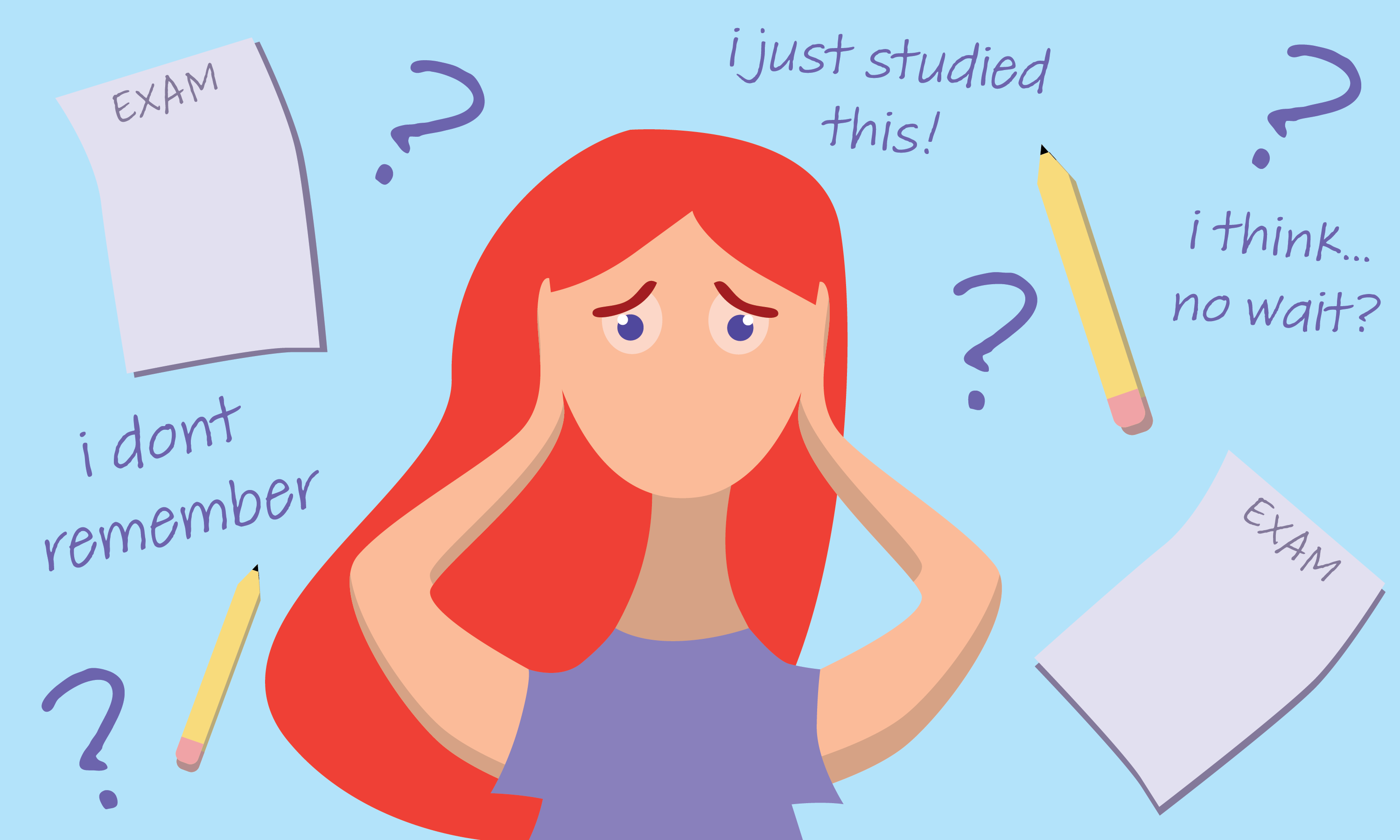
Test Anxiety: How to Relieve That Stress

Test Anxiety: How to Relieve That Stress

By: Maya Gallo

We all know exams can be nerve-wracking, especially when it comes to midterms and finals. Before we get a break, we have an overload of stress that can be overwhelming. You may ask yourself: “How can I be properly prepared for my exams while also staying calm?” Below is a list of tips to help you!

  1. Get organized: Take thorough notes. Make sure you have a calendar with all important dates coming up. Manage your time well so you know how much you can do each day.
  2. Game plan: Have a set time each day tucked away for studying. This way, you will feel better and more prepared for upcoming exams, even if you don’t have any assignments due.
  3. “Me” time: Take time out of your day to do something that you enjoy. Whether this be going for a walk, going to the gym, or listening to music, you deserve a break. You do not want all the studying to stress you out even more.
  4. Take care of your body: You come first. Make healthy choices, food is our fuel. Get plenty of sleep and listen to your body. It is the only one you have!
  5. Be creative: If you have friends in your class, consider calling them to see if they’d like to meet somewhere (like a coffee shop) and study together. Get creative with it, but have fun!

Hope this puts your mind at ease when it gets to that point in the semester. Be sure to use these tips to alleviate your stress. Good luck!

If you or someone you know is struggling with anxiety, please contact our psychotherapy offices in New York or New Jersey to talk to one of our licensed professional psychologists, psychiatrists, psychiatric nurse practitioners, or psychotherapists at Arista Counseling and Psychotherapy. Contact our Paramus, NJ, or Manhattan, NY offices respectively, at (201) – 368-3700 or (212)-722-1920 to set up an appointment. For more information, please visit https://www.counselingpsychotherapynjny.com/

References

Dealing with Exam Stress. (2025). Psychology Today. https://www.psychologytoday.com/us/blog/teen-angst/201405/dealing-exam-stress

Hypnosis: What can you do to help with your anxiety?

Hypnosis: What can you do to help with your anxiety?

By, Maro Mikhaeil

Anxiety has occurred amongst millions of individuals from all over the world. In fact, Anxiety is the most common mental illness for its effect on a wide range of individuals.

There are many treatments for individuals experiencing symptoms of anxiety. One of the most successful treatments is hypnosis, which entails hypnotic inductions. Hypnosis essentially teaches you how to be in a state of trance and deep relaxation. Hypnosis helps to decrease feelings of anxiety by keeping your emotions in check and actually helps you anchor these calm feelings. Anchoring is a technique being used here that teaches an individual undergoing hypnosis to associate to more positive triggers instead of negative ones (Leming, 2023).

Hypnosis may even allow individuals to recall memories and revisit them, in a way that decreases one’s anxiety. In other words, it may take you into a dream-like state where you will go back to the time that caused your anxiety and help you conquer it.

If you or someone you know is struggling with their mental health, severe anxiety please contact our psychotherapy offices in New York or New Jersey to talk to one of our licensed professional psychologists, psychiatrists, psychiatric nurse practitioners, or psychotherapists at Arista Counseling & Psychotherapy. Contact our Paramus, NJ or Manhattan, NY offices respectively, at (201) 368-3700 or (212) 722-1920 to set up an appointment. For more information, please visit http://www.counselingpsychotherapynjny.com/

Sources:

https://www.forbes.com/health/mind/anxiety-statistics/#:~:text=Roughly%20301%20million%20people%2C%20an,are%20affected%20by%20anxiety%20disorders

https://www.forbes.com/health/mind/anxiety-statistics/#:~:text=Nationally%3A%20Over%2040%20million%20adults,mental%20illness%20in%20the%20world.

https://www.choosingtherapy.com/hypnosis-for-anxiety/#:~:text=A%20hypnotherapist%20guides%20a%20person,focused%20awareness%2C%20and%20soothing%20suggestions.

Anxiety: Test Taking Anxiety. What is it & How to overcome it?

Anxiety: Test Taking Anxiety. What is it & How to overcome it?

By: Julissa Acebo
Do you ever experience a feeling of agitation and distress while taking an important test or exam? Followed by rapid heartbeat, muscle tension, or struggle to catch your breath? These are all symptoms of test taking anxiety which is common among many people. Some anxiety is natural and helps to keep you prepared for an exam, or mentally and physically alert, but too much can cause physical distress and/or concentration difficulties.

Test taking anxiety can:
• Impact your ability to study or perform well on a test
• Derail weeks and months of hard work
• Cause poor understanding and association of content, which inhibits your ability to recall information

Test taking anxiety tips:

  1. Be prepared
    • Talk to teacher, professor, or boss to get an idea of what to expect on the test
    • Leave ample time to study for the test. Do not wait for the night before
  2. Let go of perfectionism
    • It is impossible to learn every detail of the material that was taught
    • Focus on the most important concepts and learn them well enough to teach them
    • When you know that you have done your best and worked hard it is the only thing that matters, not the perfection.
  3. Make sure to get enough sleep the night before
    • At least 7-9 hours of a good night’s sleep will help concentration and memory
  4. Control negative thoughts
    • Counter any negative thoughts with other, more valid thoughts
    • For example, replace “I’m not good enough,” “I didn’t study hard enough,” or “I can’t do this” with “I CAN do this,” “I know the material,” and “I studied hard.”
    If all else fails, seek professional help to help you overcome your test taking anxiety.

If you or someone you know is experiencing Test Taking Anxiety, please contact our psychotherapy offices in New York or New Jersey to talk to one of our licensed professional psychologists, psychiatrists, psychiatric nurse practitioners, or psychotherapists at Arista Counseling & Psychotherapy. Contact our Paramus, NJ or Manhattan, NY offices respectively at (201) 368-3700 or (212) 722-1920 to set up an appointment. For more information, please visit https://www.counselingpsychotherapynjny.com

Sources:
https://shcs.ucdavis.edu/health-topic/test-taking-and-anxiety#:~:text=Test%20anxiety%20is%20a%20feeling,emotional%20upset%2C%20and%20concentration%20difficulties.
https://www.brown.edu/campus-life/support/counseling-and-psychological-services/managing-test-anxiety
https://northhowler.com/2291/news/test-anxiety-affecting-students/

Anxiety and Tests

Anxiety and Tests

 As universities are opening up and students are returning back to the classroom, students may feel increases in test anxiety as they return to an academic setting. While some anxiety may be a good motivator for studying, a crippling amount of anxiety can result in a decrease in grades and an increased risk of mental health issues. Here are some tips to conquer testing anxiety.

  • Study Smarter, Not Harder: Make sure you’re prepared for the test. Don’t cram and don’t spend too long stressing over the subject. Ask friends and family for help, and set goals to help you reach your potential in different subjects.
  • Focus on the positives: Negativity can be a self-fulfilling prophecy. If you tell yourself you’ll do poorly, you’ll end up not having the motivation to study and thus do poorly. Practice positive self-talk and set realistic goals for yourself.
  • Build Good Habits: Manage your time wisely. Make sure to get enough sleep the day before the test and eat something nutritious the morning of the test.
  • Do Relaxation Exercises: There are a number of ways to alleviate physical symptoms. Do breathing exercises, count backwards from one hundred, and meditate. Find out which relaxation technique works best for you.

            As everyone returns to the classroom there will be an adjustment period. Be proactive in helping your test anxiety and practice the methods that work best for you.

If you or someone you know is seeking therapy for an anxiety disorder, please contact our psychotherapy offices in New York or New Jersey to talk to one of our licensed professional psychologists, psychiatrists, psychiatric nurse practitioners, or psychotherapists at Arista Counseling & Psychotherapy. Contact our Paramus, NJ or Manhattan, NY offices respectively, at (201) 368-3700 or (212) 722-1920 to set up an appointment. For more information, please visit http://www.counselingpsychotherapynjny.com/

SOURCE: https://www.therapistaid.com/therapy-guide/treating-test-anxiety#references

Anxiety and Bullying

Image result for anxiety and bullying


Anxiety and Bullying

By: Vanessa Munera

Being bullied is not an easy thing to handle. It can be a traumatic experience for teens that are being targeted. Those who are bullied experience impacts in their lives such as feeling lonely, anxious, isolated, and vulnerable. Unfortunately, when a bully moves on to the next target, these consequences of bullying linger longer for the victim. After prolonged exposure, victims of bullying can develop adverse effects. These victims will experience depression, eating disorders, and thoughts of suicide. In addition, victims of bullying can develop some sort of anxiety disorder. The top four major anxiety disorders victims of bullying can experience are Post-Traumatic Stress Disorder (PTSD), generalized anxiety disorder (GAD), panic attacks and social anxiety disorder.

  1. Post-Traumatic Stress Disorder (PTSD): this occurs after a traumatic or life-threatening event. PTSD can develop due to events such as a car accidents or losing a close relative. This disorder can also show up after repeated abuse or even bullying. Children who are bullied may experience nightmares, flashbacks, withdraw from others, or are easily startled. Kids, who undergo long term and abusive bullying, have increased chances of developing PTSD.

2. Generalized Anxiety Disorder (GAD): Kids with GAD are often tormented with worries and fear that distract them for their daily life activities. Those with generalized anxiety have a constant feeling that something bad is going to happen. This is not uncommon with victims of bullying. With GAD, physical symptoms may appear such as insomnia, stomachaches, fatigue, and restlessness.

3. Panic Attacks: Those who suffer from panic disorders must deal with unpredictable and repeated attacks. When suffering from a panic attack, the attack is usually with no warning and can cause physically symptoms. These symptoms include sweating, chest pain, and rapid or irregular heartbeats. In fact, a part of the brain called the amygdala plays a pivotal role in panic attacks. When left untreated, the sufferer will begin to avoid going out or things they once enjoyed, in order to prevent another panic attack.

4. Social Anxiety Disorder: People who suffer from social anxiety fear being humiliated or seen negatively by others. Those with this disorder often worry that the way they look or act cause others to mock them. This can cause sufferers to avoid social gatherings to avoid being humiliated. In fact victims of bullying often develop social anxiety due to the repeated shame and public humiliation they experienced.

If you or a loved one appears to be suffering from an Anxiety Disorder, the licensed psychologists, psychiatrists, psychiatric nurse practitioners, and psychotherapists at Arista Counseling & Psychotherapy can assist you. Contact our Paramus, NJ or Manhattan, NY offices respectively, at (201) 368-3700 or (212) 722-1920 to set up an appointment. For more information, visit http://www.counselingpsychotherapynjny.com/


References:

https://www.verywellfamily.com/bullying-and-anxiety-connection-460631

https://www.stopbullying.gov/blog


Anxiety: Test Taking

Anxiety: Test Taking

By Toniann Seals

Many students are exceptional in class, but find themselves below average on tests (both in class and standardized). How can the student who is continuously participating, going to extra tutoring sessions and always asking questions failing tests? There is a chance they are suffering from test taking anxiety.

Symptoms of test anxiety

While testing:

  • Shaking
  • Nausea
  • Forgetfulness
  • Hot flashes

Effects of test anxiety

  • Feelings of not being good enough
  • Feeling as though you are a failure
  • Negative thoughts
  • Lack of self esteem

Overcoming test anxiety is something that can be handled with a professional, however there are ways you can help yourself in the meantime.

Coping mechanisms

  • Begin studying early so you feel more confident and less anxious
  • Have open communication with your teacher so they understand what you are going through
  • Get enough sleep the night before
  • Meditation can help anxiety
  • Create affirmations and positive thoughts where you picture yourself doing well

If you or someone you know is dealing with anxiety speak with one of our licensed professional psychologists, psychiatrists, psychiatric nurse practitioners, and psychotherapists. Contact us at our Paramus, NJ or Manhattan, NY offices at (201) 368-3700 or (212) 722-1920 respectively to set up an appointment. For more information, visit http://www.counselingpsychotherapynjny.com/.

Source:

https://www.mayoclinic.org/diseases-conditions/generalized-anxiety-disorder/expert-answers/test-anxiety/faq-20058195

(Image) https://www.psycom.net/test-anxiety-quiz-assessment/

Assertiveness and Anxiety: How Expressing Yourself Can Lead to a Happier Self

By: Sanjita Ekhelikar

“Communication is key” is a phrase we are all familiar with, yet many struggle with actually acting on it. The most effective form of communication is through assertiveness, which involves expressing one’s views in a straightforward manner, and in standing up for one’s needs while still being considerate of others. This differs from aggressiveness in that it does not involve being outwardly emotional or insulting to others, and differs from passivity in that the individual clearly states their feelings and desires. Being assertive involves open communication, which can be difficult to engage in, especially for people struggling with anxiety. However, through practicing and learning assertiveness, people with anxiety can actually feel less worry and more confident in themselves.

Anxiety describes the uncomfortable feelings of turmoil and dread that one might have in anticipation that results in physical sensations such as rapid heartbeat, sweating, and rumination. For many who struggle with anxiety, the thought of being assertive with others makes them anxious. They often worry that being assertive will come off as being mean, creating conflict, and being inconsiderate. Therefore, many choose passive communication, and never voice their views or feelings. This worsens their state of worry, as they are not properly understood by those around them and can easily be taken advantage of. They are often misunderstood which increases their worry. Others often take advantage of them because of their meek manner and visible anxiety.

Contrary to what those with anxiety believe, assertiveness can actually help them feel better. Often times, those with anxiety create situations in their mind about everything that will go wrong if they voice themselves to another person. However, such a form of open communication can create a better understanding between two people. It allows the person with anxiety to be properly understood, to dispel the fearful thoughts in their head, and become more confident in themselves and their views.

How can people with anxiety begin working towards being more assertive? By stating their views using “I,” individuals can avoid putting blame on others by expressing their own opinions. In addition, reminding themselves that their fears are not rational and that it is their anxiety talking to them can help them become increasingly comfortable with being assertive. Finally, practice makes perfect – keep trying and speak up!

If you or someone you know is suffering from anxiety, please contact our psychotherapy offices in New York or New Jersey to talk to one of our licensed professional psychologists, psychiatrists, psychiatric nurse practitioners, or psychotherapists at Arista Counseling & Psychotherapy. Contact our Paramus, NJ or Manhattan, NY offices respectively, at (201) 368-3700 or (212) 722-1920 to set up an appointment. For more information, please visit http://www.counselingpsychotherapynjny.com/.

Anxiety: Test Anxiety

By: Charleene Polanco

Have you ever had a moment of extreme panic, right before the beginning of a test? How about feeling like you are about to faint, or excessive sweat during an exam? If these symptoms describe your test-taking experience, then you might be suffering from test anxiety.

Test anxiety is defined as a psychological condition where people experience severe distress and anxiety during exams. Some causes of test anxiety are fear of failure and lack of preparation. A fear of failure can result from wanting to perform well. One who associates their self-worth with a test’s outcome, can feel devastated when the grade is not what he or she expected. This creates a vicious cycle, where because the person is afraid of feeling worthless, when they fail, they become anxious while taking the exam.  As a result, their performance level on tests drops. Lack of preparation is another cause of test anxiety, which occurs when students do not study properly for an exam. For those who like to wait until the night before an exam, to cram five chapters worth of information into their brain, tests are a constant source of anxiety and stress.

Symptoms of test anxiety can be split up into three categories; physical, emotional, and behavioral/cognitive symptoms. Some physical symptoms include headaches, nausea, excessive sweating, and rapid heartbeat. Emotional symptoms can be expressed as feelings of anger, fear, helplessness, and disappointment.  Behavioral/cognitive symptoms are difficulty concentrating and negative thinking.

To help manage test anxiety, here are some tips;

  • Properly prepare for exams
  • Develop good test-taking skills
  • Engage in relaxation techniques, like taking deep slow breaths
  • Keep a positive mindset

If you or someone you know is suffering from test anxiety, please contact our psychotherapy offices in New York or New Jersey to talk to one of our licensed professional psychologists, psychiatrists, psychiatric nurse practitioners, or psychotherapists at Arista Counseling & Psychotherapy. Contact our Paramus, NJ or Manhattan, NY offices respectively, at (201) 368-3700 or (212) 722-1920 to set up an appointment. For more information, please visit http://www.counselingpsychotherapynjny.com/.

Source:

“Test Anxiety.” Anxiety and Depression Association of America, ADAA, Anxiety and Depression Association of America , 2018, adaa.org/living-with-anxiety/children/test-anxiety