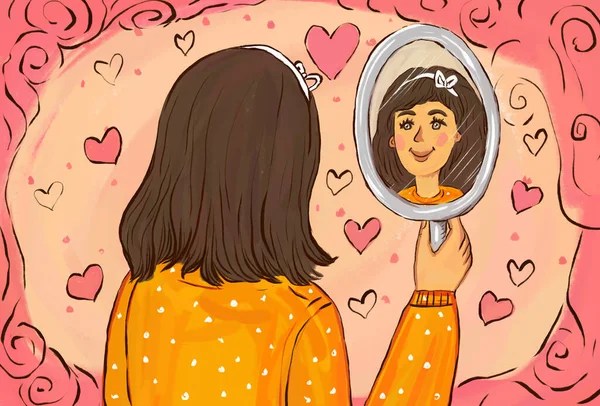
Self-Love: Learning to Love YourSELF

Self-Love: Learning to Love YourSELF

By: Michelle Cocone

February is known to be the month of love, spreading love to our loved ones. We spend a lot of time trying to share that love that we often forget about ourselves. It’s important to learn how to love yourself. It helps us lead a healthier life and have better mental health. When we don’t love ourselves, it takes a toll on us, possibly leading to depression, anxiety, or an eating disorder. There are many ways to show love to ourselves, here are a couple ways.

Shift Your Perspective

  • Focusing on the bad aspects of ourselves won’t lead to anywhere good
  • Shift your perspective towards a more positive outlook
  • Don’t always see the cons, recognize the pros as well, they need love too

Affirmations

  • Write out a list of what you like + love about yourself
  • Tell yourself that you appreciate all parts of  your body/personality
  • Embrace the beauty of it all
  • Remember your body does plenty of work to keep you going every day
  • Keep telling yourself all these affirmations throughout the low points you may have

Practice Self-Love

  • Focus on the hobbies that you enjoy
  • Pour yourself  into becoming better at your hobbies
  • Be kind to yourself, you only have one body, so take care of it
  • Learn to forgive yourself when you haven’t accomplished everything you hoped for
  • Learn to forgive yourself when you aren’t kind to yourself
  • It’s okay to say “No.” You don’t have to please others all the time.

The most important relationship you can have is with yourself.  You may have heard this saying once or twice but it’s true, “Learn to love yourself first so you can spread love to others.”  Make time to focus and nourish your own self. It doesn’t all get done in one day. As long as you work on yourself a little bit every day that’s all that matters.

If you or someone you know is struggling with self-love, please contact our psychotherapy offices in New York or New Jersey to talk to one of our licensed professional psychologists, psychiatrists, psychiatric nurse practitioners, or psychotherapists at Arista Counseling and Psychotherapy. Contact our Paramus, NJ or Manhattan, NY offices respectively, at (201) – 368-3700 or (212)-722-1920 to set up an appointment. For more information, please visit https://www.counselingpsychotherapynjny.com/

References

Improving every area of your life starts with self-love. Improving Every Area of Your Life Starts with Self-Love | Tony Robbins. (n.d.). https://www.tonyrobbins.com/ultimate-relationship-guide/how-to-fall-in-love-with-yourself?srsltid=AfmBOoq4CvACby5hWenBdEGAH5zBgxAPOtKzEvtobHDRZ6cGfT9MaFtn


Pomlett, M. (2020, December 21). Learn how to self-love. Psychological Health Care. https://www.psychologicalhealthcare.com.au/blog/learn-how-to-self-love/

Shopping Addiction? Can’t Save Money? That May Be A Real Issue

Shopping Addiction? Can’t Save Money? That May Be A Real Issue

By Erika Ortiz

             Most people like to spend and buy things, but some take that splurging a bit to the max and do it any opportunity possible. Shopping makes some feel good, however; some get this “high” feeling since the brain releases endorphins and dopamine as they shop. It’s one thing to shop while on a budget, while it’s another to shop with no budget in mind. All of the spending, unnecessary buying, and accumulation of debt is an actual issue called shopping addiction. It is imperative to break down shopping addiction and the different types. First, there is impulse buying which is buying something you did not plan on purchasing in the first place. It can range from buying a chocolate bar from the grocery store while waiting in line or buying your 50th pair of shoes. Compulsive buying is when you plan your shopping, but to an extreme and on unnecessary items. Compulsive buying is usually where the shopping addiction behavior occurs most. For example, say you did not do so well on an exam or had a bad day at work, your immediate solution is to go shopping afterward to make yourself feel better. Another type is bargain shoppers who think they are getting a steal price or great deal. They are still spending a lot instead of saving. Finally, there is bulimic shopping or circular shopping. These people buy and return just for fun; even though they are staying within their budget, they are wasting a lot of time and energy.

           Shopping addiction can be due to stress, loneliness, sadness, the need to fill a void, lack of control, avoidance of reality, depression, anxiety, etc. Nonetheless, this is a severe problem that needs an urgent solution because shopping addiction can lead to issues in relationships, growing debt, constant overspending, and even lying about spending. One way to help with this issue is to create a budget and try sticking with it. There are many resources online that can be great budgeting tools. It is critical to immediately get help if you have a very severe case of shopping addiction. Seek a mental health professional who can help you get to the root of the issue and understand what you are going through. Remember that there is hope and you can get through this.

If you or someone you know is struggling with a shopping addiction please contact our psychotherapy offices in New York or New Jersey to talk to one of our licensed professional psychologists, psychiatrists, psychiatric nurse practitioners, or psychotherapists at Arista Counseling & Psychotherapy. Contact our Paramus, NJ or Manhattan, NY offices respectively at (201) 368-3700 or (212) 722-1920 to set up an appointment. For more information, please visit https://www.counselingpsychotherapynjny.com

Sources

https://www.ramseysolutions.com/budgeting/shopping-addiction

Eating Disorders: How To Catch Them in Your Loved Ones

Eating Disorders: How To Catch Them in Your Loved Ones

By Emily Ferrer

Eating disorders are characterized by severe and persistent troubles related to eating behaviors, food, and weight[1]. There are many different types of eating disorders; however, the most common are anorexia nervosa, bulimia nervosa, and binge eating disorder. Nine percent of the entire population suffers from an eating disorder and 10,200 deaths are recorded each year due to an eating disorder[2]. After reading about how common they are, I am sure you are wondering, “How do I know if I or someone I know has an eating disorder?” There are many signs and symptoms associated with eating disorders[3]:

Anorexia Nervosa:

  • Extreme weight loss
  • Muscle weakness
  • Bone weakness
  • Amenorrhea
  • Brittle hair/nails
  • Always feeling cold
  • Obsession with food
  • Depression

Bulimia Nervosa:

  • Frequent trips to the bathroom after a meal
  • Chronic sore throat
  • Dental decay
  • Laxative/diuretic misuse
  • Large amounts of food disappearing
  • Fainting from excessive purging

Binge-Eating Disorder:

  • Weight gain
  • Eating very rapidly
  • Eating until very full
  • Eating even when not hungry
  • Hiding large amounts of food
  • Eating alone on purpose
  • Feeling guilty after eating large amounts of food

Eating disorders can be extremely serious if not treated. It is important to stay informed about the signs and symptoms of different eating disorders so you can find help for you or someone you know as soon as possible. Other general signs of eating disorders to look out for are a sudden obsession with food (cooking it, eating it, watching cooking shows/videos), social withdrawal, drastic changes in mood, new attitudes towards food, new dieting habits, self-harm, excessive exercise, obsession with calorie and step count, repeatedly weighing themselves, and body dysmorphia[4]

If you or someone you know is struggling with an eating disorder, please contact our psychotherapy offices in New York or New Jersey to talk to one of our licensed professional psychologists, psychiatrists, psychiatric nurse practitioners, or psychotherapists at Arista Counseling & Psychotherapy. Contact our Paramus, NJ or Manhattan, NY offices respectively, at (201) 368-3700 or (212) 722-1920 to set up an appointment. For more information, please visit http://www.counselingpsychotherapynjny.com


Sources:

[1] https://psychiatry.org/patients-families/eating-disorders/what-are-eating-disorders

[2] https://anad.org/eating-disorders-statistics/

[3] https://psychiatry.org/patients-families/eating-disorders/what-are-eating-disorders

[4] https://www.lifeworkscommunity.com/eating-disorders-treatment/how-to-recognise-the-early-signs-of-an-eating-disorder

Depression and Humor

By Katie Weinstein

Humor is not only used as a way to get a good laugh with friends, but as a coping mechanism to defuse a situation. Using a positive humor style is associated with good health outcomes, but using a negative humor style, such as self-deprecation, is linked to depression.

It is important to know how to laugh at yourself, but it is also important to know when your self-deprecating has gone too far and is leading to depression. Some signs might be that you can’t take a compliment or that it is a reflex to use self-deprecating humor since this is indicative of low self-esteem. It is easy to justify self-deprecating humor as not wanting to sound too arrogant, but if you use it alone, this is a major warning sign since no one will be there to laugh at your jokes. Another sign might be that you start to actually believe what you’re saying. The point of self-deprecating humor is to make light of imperfections, not to validate insecurities. When you’ve gone too far with self-deprecating humor, the people around you might either tell you this or stop laughing at that type of humor since it makes other people uncomfortable.

The relationship between self-depreciative humor and depression remains unclear as to which causes the other or if there is a cyclical effect between the two. It is possible that people who are depressed choose a self-deprecating humor style because they are attempting to cope with low self-esteem or it is possible that repetitive negative humor causes low self-esteem and depression. A third possibility is that genetic and environmental factors affect depression and negative humor styles.

One way to stop using self-deprecating humor is to fight the urge to put yourself down when someone compliments you and just say thank you. Being cognizant of when you are using self-deprecating humor and the way the way that it makes you feel is important for helping you to stop using it.

If you or someone you know is experiencing low self-esteem and or depression please contact our psychotherapy offices in New York or New Jersey to talk to one of our licensed professional psychologists, psychiatrists, psychiatric nurse practitioners, or psychotherapists at Arista Counseling & Psychotherapy. Contact our Paramus, NJ or Manhattan, NY offices respectively, at (201) 368-3700 or (212) 722-1920 to set up an appointment. For more information, please visit http://www.counselingpsychotherapynjny.com/

https://www.psychologytoday.com/us/blog/humor-sapiens/201911/the-relationship-between-humor-and-depression