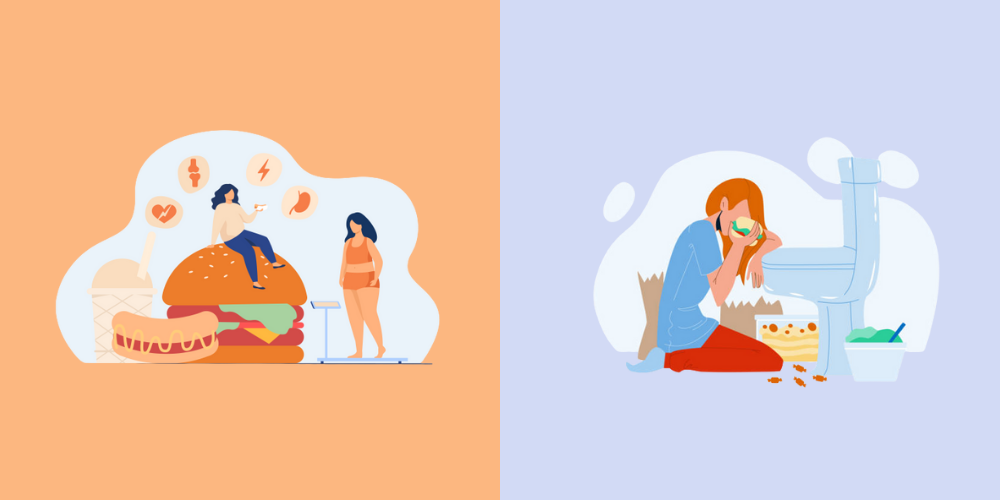
Bulimia and Binge Eating Disorder: Similarities and Differences
By: Diane Ulloa
Bulimia as categorized by the DSM V under bulimia nervosa is a diagnosis assigned to individuals who recurrently overeat and use inappropriate measures to prevent weight gain afterwards, such as purging, fasting or exercising excessively. A criterion would include, “Recurrent inappropriate compensatory behaviors in order to prevent weight gain such as self-induced vomiting; misuse of laxatives, diuretics, or other medications; fasting or excessive exercise” (National Library of Medicine).
There are 5 criterion for binge eating disorder that include:
- Eating in a discrete period of time (within 2 hour periods), an amount of food that is larger than most people would eat in a similar period of time under similar circumstances. A feeling that one cannot stop eating or control what or how much one is eating. . Eating until feeling uncomfortably full, eating large amounts of food when not feeling physically hungry.
- Recurrent inappropriate compensatory behaviors in order to prevent weight gain such as self-induced vomiting; misuse of laxatives, diuretics, or other medications; fasting or excessive exercise
- The binge eating and inappropriate compensatory behaviors occur, on average, at least twice a week for 3 months.
- Self-evaluation is unjustifiably influenced by body shape and weight.
- The disturbance does not occur exclusively during episodes of anorexia nervosa.
Both have the shared behavior of binge eating food, but what is binge eating? When someone cannot control their eating and they eat much more food than they would normally eat in one sitting often to the point of major discomfort. Oftentimes binging happens when one is not hungry and many report binge eating home alone, or at night when no one is up or around to see them. People may binge eat as a coping mechanism when they are stressed, anxious, bored, or experiencing any other negative emotion. For those struggling with bulimia, binging and then purging can be a way of coping with those negative emotions. For someone who struggles with binge eating disorder, binging can also be a way to self-soothe or distract in the presence of very difficult emotions. Many people who engage in these behaviors have feelings of social isolation and anxiety, and many have reported feeling hopeless and helpless.
What’s the difference? The main difference is that bulimia nervosa is characterized by purging after binge eating. While everyone has very different reasons and experiences, often those who struggle with bulimia also struggle with gaining weight and often have a distorted body image. As opposed to those with binge eating disorders who may feel uncomfortable in their bodies, but do not have as strong preoccupation with their body image, or weight, as those with bulimia.
If you or someone you know is struggling with their mental health, bulimia nervosa, or binge eating disorder please contact our psychotherapy offices in New York or New Jersey to talk to one of our licensed professional psychologists, psychiatrists, psychiatric nurse practitioners, or psychotherapists at Arista Counseling & Psychotherapy. Contact our Paramus, NJ or Manhattan, NY offices respectively, at (201) 368-3700 or (212) 722-1920 to set up an appointment. For more information, please visit http://www.counselingpsychotherapynjny.com/
Sources:
Substance Abuse and Mental Health Services Administration. DSM-5 Changes: Implications for Child Serious Emotional Disturbance [Internet]. Rockville (MD): Substance Abuse and Mental Health Services Administration (US); 2016 Jun. Table 20, DSM-IV to DSM-5 Bulimia Nervosa Comparison. Available from: https://www.ncbi.nlm.nih.gov/books/NBK519712/table/ch3.t16/
Berkman ND, Brownley KA, Peat CM, et al. Management and Outcomes of Binge-Eating Disorder [Internet]. Rockville (MD): Agency for Healthcare Research and Quality (US); 2015 Dec. (Comparative Effectiveness Reviews, No. 160.) Table 1, DSM-IV and DSM-5 diagnostic criteria for binge-eating disorder. Available from: https://www.ncbi.nlm.nih.gov/books/NBK338301/table/introduction.t1/
https://www.centralcoasttreatmentcenter.com/blog-1/bulimia-v-binge-eating-disorder

 CounselingRx